Category: creativity

  • the art of noticing ~ free two week photo challenge

    join us inside her way club December 17–31, 2025

    DEC 10, 2025

    It’s 7:31 am. I just opened my laptop to write this email to you. Only to notice that an old draft of it had already been sent out! I have no idea how or why… It wasn’t in my scheduled drafts. And more importantly, it wasn’t ready! So let’s try this again…

    Two tall candles are flickering on the bedside to the left of me. A freshly made hot ginger tea is steaming to the right of me. Nothing but darkness and the occasional window light being turned on or off is visible through my French door windows. Mostly, it is pitch black. 

    Early in the morning, when I first wake up, has always been my favourite way and time of day to sit down and connect with you like this. Lately, it’s been happening less than I would like.

    It’s been one of those times where the days and weeks merge and melt into each other. I look up from my life that is all-consuming in various iterations of growth, and cannot tell if it’s Saturday or Thursday or Monday. In fact, this year felt like it folded in on itself in March and then came back out in November, making it 4 months instead of 12.

    I have chosen to surrender to it all. The lack of certainty, the lack of environmental consistency, the lack… lack lack lack… I say ‘lack’, but what it really is, is an emptying out. The things I deeply yearn for cannot come from lack nor from fullness. They can only come from space. 
    the art of noticing ~ photo challenge

    Every December, I want to notice and savour the calendar year just passed, and this year I feel something different asking to come through: a communal ritual, a way of remembering beauty together. A way of closing the year not through analysis or productivity or resolutions, but through presence. Through the practice that has quietly held me through so many seasons: noticing.

    Noticing is my way home. It is a return to the small, the immediate, the sensory, the real. It is a nervous system soothing mechanism disguised as creativity. A micro-dose of aliveness. A gentle psychological intervention. And when a few of my students from The Art of Noticing writing club asked if I’d offer a two-week photo challenge to help us all see the beauty in our everyday lives… I said, “Yes, of course! I’d love that!”.

    So I’m opening it to everyone: the whole extended circle of people who orbit these pages. 

    You can join right here: https://stan.store/herwayclub/p/join-her-way-club for free.

    A free, two-week invitation into the world as it actually is: imperfect, unguarded, quietly shimmering. A collective exhale at the end of a hard year. A bridge ritual between what has been and what is beginning.


    The Art of Noticing: 14 Days of Everyday Beauty
    December 17–31

    her way club

    It’s a gentle daily nudge toward a softer gaze. One prompt each morning. One photo each day. A moment you saw that you might otherwise have walked past. A flicker of light, a corner of rest, a colour that feels like hope, a texture that surprises you, a symbol of care you didn’t know you needed.

    We’ll move through the world together in a slow arc:

    from the external world → inward → relational → closing → opening again.

    A choreography of attention. A small pilgrimage. A way to let the year exhale through you.

    When you notice beauty during hard times, beauty becomes the thing that carries you through. This is the paradox at the heart of the challenge. People often imagine they must feel better before they can see beauty, but the act of seeing is often what begins the softening. This practice flips the sequence.

    Over the 14 days, we’ll notice:

    light as it finds us
    unexpected softness
    what stayed
    quiet corners
    the simplest joy
    the colour of hope
    and the doorway into the next year

    The prompts are intentionally simple because simplicity is the practice. This is about reconnecting with beauty and your creativity. A photo is small enough not to activate perfectionism, but meaningful enough to reveal something true. A way to express without effort. A way to see without striving.

    And we’ll do it together, in community — because when a group notices beauty at the same time, everyone’s eyes sharpen. My noticing widens yours. Your noticing shifts mine. We become a shared lens, a communal field of attention, each of us offering the day back to each other in the form of a single captured moment. This is how ordinary days become luminous.

    The vibe:
    gentle, imperfect, real.
    cosy in the quiet-hours sense.
    a place to land at the end of each day.
    zero pressure. no catching up. come as you are, miss a day, rejoin, it doesn’t matter.
    a slow collective walk toward the threshold of a new year.

    Your next steps:
    Join the challenge inside the community space. It’s free. You can come alone or bring a friend. You’ll get the daily prompt, you’ll take the photo, and you’ll share it if you want to, with words or without. You can scroll through the others’ posts each night, letting their way of seeing alter your own. And at the very end, on December 31, we’ll close with a final moment of stillness. A breath shared across distance.

    If you’ve felt rushed, overwhelmed, disconnected from yourself, numb, or stretched this year — come. If you’ve wanted to make something but haven’t had the energy — come. If you’ve longed for softness, for ritual, for a simple way to feel more alive — come.

    This is a doorway disguised as a challenge. A ritual disguised as a photo exercise. A remembering disguised as something casual. It’s not about taking pictures. It’s about noticing your life with an eye looking for beauty and a gentler gaze.

    I can’t wait to spend these 14 days with you.


    Join here:

    her way club 2 day photo challenge

    To make your experience smoother:

    • Save your login details. You’ll likely need to sign in more than once, so it’s best to store your username and password in your password manager.
    • Bookmark the community link in your browser, so you don’t have to search for the invite email each time.

    You can also download the Stan Community app to your phone for easy access (or do both, whatever feels simplest):

    1. Search for “Stan Community” in your mobile app store.
    2. Install and open the app.
    3. Sign in using your Stan Store login details.

    Once inside

    Come say hello! Post a short introduction with a photo, your name, and where you’re based, plus a few lines about what you hope to experience here and a little bit about you.

    We begin next week on Wednesday, December 17.
  • practical dreamer

    DEC 03, 2025

    We were about to run the scene for the first time on the first day when I smelled it. A warm, unmistakable wave of alcohol came off her breath as she leaned in. I froze for half a second, confused. It was 10 a.m. on a Thursday. Was she drunk? 

    I pulled myself back into character because that’s what we were supposed to be doing: acting. I’d come to this six-week course specifically to shake loose my own edges a bit, to remember what it felt like to inhabit someone else’s skin on purpose. A small, secret hope tucked inside this decision, too: maybe this would reopen something creatively, or at least remind me that I am not just one self, stuck on one track.

    She was the kind of person you’d assume had everything under control. A known actor with a recent Netflix role, returning to her craft after time away. She carried what looked like a berry smoothie — dark purple, very wholesome — and sipped it throughout class. Except the smell told a different story. 

    After class, a friend picked me up to go to the beach. I tried to explain what had happened in that confused way you do when you’re still half convinced you imagined the whole thing. I didn’t say who she was. I just kept circling around the fact of it: “And it was ten in the morning!”

    Later that night, still unsettled, I drafted a short email to the head acting school teacher. Careful, almost apologetic. I wasn’t accusing her of anything; I just… didn’t know what to do with the information. I hit send, regretted being that earnest student who “brings things up,” and went to bed. By morning, I had a reply. It said I was making “very serious allegations,” which is the kind of phrase that makes you feel both scolded and slightly gaslit. I closed my laptop and told myself to drop it. Fine. Whatever. Maybe I was overreacting.

    Over the next six weeks, there was a pattern. She’d slip out “for a coffee” or “to use the bathroom” right before her turn to perform, and come back looser, warmer, more emotionally elastic. She could give these huge, convincing performances — crying, shouting, collapsing — but something about them felt off. And I kept thinking, in that uncomfortable way you think the thing you don’t want to think: Is she showing up to actual paid work like this? Is this just… normal?

    The part that really stayed with me was the recognition of the dynamic underneath it. The quiet splitting from oneself. The subtle, daily ways people disconnect just enough to get through whatever their life requires of them. 

    Not always with alcohol. Sometimes, with edibles. More often, it’s things like keeping yourself too busy to notice you’re unhappy, or telling yourself a story that makes a relationship seem “fine,” or eating in that way that feels like both comfort and punishment. 

    The constant hum of distraction, or getting very invested in “being productive,” or deciding that honesty is optional if it keeps things smooth. All the tiny, acceptable ways we avoid being fully present with our own lives.

    Most people live like this. It’s not a moral failing. It’s a lack of awareness. A kind of spiritual autopilot. Some people live inside the roles they inherited, and others rewrite the script. Some people pretend a life, and others create one. 

    And the latter — the creators — are the ones I think of as practical dreamers.

    A practical dreamer is someone who understands that dreaming without doing is self-indulgent and doing without dreaming is pointless. They are people who keep their heads in the clouds, yes, but with their feet solidly planted on the ground. They refuse to separate beauty from utility, vision from labour, desire from action. They inhabit both their aspirations and their realities with equal care, even when one terrifies them, and the other bores them.

    Now, in this cultural moment, the stakes are higher. So many people spend their days worried that AI will steal something essential from them: their jobs, their livelihoods, the delicate illusion that they are in control of anything at all. 

    It is possible, but only if you are passive.

    If you are operating on autopilot, if you are waiting for someone — a boss, a system, a timeline — to tell you what your life should look like. Because the only way to remain alive, relevant, and whole is to choose your life. To choose it in all its contradiction and uncertainty, in all its mess and joy. To embrace your interiority, your curiosity, your irrational impulses, your instincts, and your mistakes, and to act anyway. The only way to outperform a machine is to be aggressively human. 

    What is more human than to be the creator of your life? No machine can do that for you.

    Entrepreneurship is one way to be a creator. It is about asserting yourself in the world in alignment with what you know, with what you are capable of, with what only you can offer. Freelancers, mentors, portfolio careerists, boutique founders, artists who monetise their craft, consultants who build their own frameworks, all of these are entrepreneurs. All of these are people who refuse to wait for permission, who choose to generate value from their own skills, curiosities, and insights. 

    Entrepreneurship is spiritual because it forces you to confront yourself. It forces you to notice where you hide, where you lie, where you numb, and it asks you to act anyway. It forces you to take responsibility for the way you show up as a human, as someone whose labour is not just transactional but creative, generative, alive. It illuminates your weaknesses and strengths and asks you to work with them, to outsource, to collaborate, to ask for help, to become stronger in the ways that matter most.

    I am, by most definitions, the most unlikely entrepreneur. I do not follow trends. I do not invest in long-term content plans or rigid business strategies. I believe in changing my mind, repeatedly, until I find the approach that feels right for me. I believe in knowing myself deeply — Jungian style — so that when I claim my value in the world, it is not borrowed, copied, or acted, but entirely mine. 

    I believe in noticing what excites me, what makes my pulse quicken, what pulls me forward, and letting that guide me. I believe in trusting the process, even when certainty is impossible, because certainty is an illusion and clarity is built through iteration, through showing up, through experimentation. 

    I believe that the person you should always invest in most is yourself.

    My own life — the way I structure it, inhabit it, show up in it — is my most powerful client magnet. It demonstrates that a life built on curiosity, attention, intention and deliberate action works. That it is possible. That it is magnetic. It proves that what I teach is not theory; it is practice.

    Perhaps why Practical Dreamer sold out so, so quickly. So quickly, I opened up new spaces starting next year. And why many clients move on to rolling monthly mentoring programs, working together for six months to a year to build lives that are aligned, generative, and resonant. 

    — For anyone new to my work, I am offering a December special: $100 off a Single 90-minute Mentoring session, scheduled this month. 

    — For those ready to leap, I am accepting new clients next year for the 1-Month Intensive, a space to clarify, align, and build a framework that matches your unique gifts and rhythms. 

    Spaces are limited, and the first step is simply to reach out and start the conversation.

  • outer life

    6/8 — the sixth rule of her way club (aka: how to change your life in 6-12 months)

    OCT 15, 2025

    Continuing our 8 rules of her way club series. If you’re just joining, begin here:

    1/8 — deciding to play by your own rules
    2/8 — subtracting what doesn’t belong
    3/8 — the natural consequence: uncertainty
    interlude — her way deep rest
    4/8
     — trust yourself
    5/8 — inner life
    6/8 — outer life


    Before we continue, 2 important things:

    1. Next week, starting on Tuesday with the New Moon 🌚, I am gathering a small circle of writers and dreamers for six weeks of writing together for The Art of Noticing. I’d love you to join me. Doors close on Saturday at midnight. Join here.
    2. Please continue completing this questionnaire. The competition ends at the end of this week. If you haven’t completed it yet (and you’d like the gift of working with me 1:1), please, do so here.

    Life changes in an instant. The ordinary instant. You choose a new way to view your life, and suddenly it takes on an entirely new flavour and trajectory.

    I remember the day that I decided to devote myself to living a life that is truly my own. I was living in Venice, just a couple of blocks back from the beach in Los Angeles. It was a sparkly late September afternoon, the sun in that part of the world a generous haze that fractures the light, scattering it in such a way that there are no shadows. I had just come home from a date with a curly-haired actor who lived in a garage and was delusionally committed to his acting career. If he can be so devoted to his dream, so can I, I decided.

    My dream was not anchored in what my life would look like, but how it would feel.

    I want a life that feels soul-led, heart-driven, alive, romantic, bohemian, and rich. I want a life that, if at any given moment it comes to an end, every moment of it was well-lived and full.

    On that afternoon in Venice, I surrendered my motivation for curating a life that looks good on the outside for a devotion to one that feels good on the inside. And to allow my outer life to be a co-creation between me and a higher power based on my inner life and essence.

    At first intentionally, and more recently, with a stronger desire to find my place, I have been moving between cities and countries, following the rhythm of my life and the quiet pull of my work. I don’t have a dedicated office or a desk that anchors me, but I have something far more powerful: a dedication to my expression and my work and as an extension of both, to my writing that exists in my mind, in my days, and in the life I’ve intentionally crafted. 

    On some mornings, I write in a sunlit café overlooking cobbled streets; on others, in a small apartment with the hum of a city below me. Sometimes, I’m sitting cross-legged on a patch of grass under a tree, letting my notes scatter into the wind. The space itself is secondary. What matters is the commitment, the devotion, and the intentionality I bring to it.

    This is what outer life is really about: creating the conditions for your inner world to find expression.


    The first five steps of this series built the internal architecture for this moment. 

    You’ve taken back your power, carved space for yourself, leaned into uncertainty, trusted your instincts, and begun tending your inner life. Now, all of that work begins to take shape. This is where the choices you make daily, deliberately, insistently, start to build a life that reflects your authentic self. 

    You must understand this: your outer life is a reflection of your inner life. The more intimately you know yourself, the more consciously you can build the world around you.

    Outer life can be divided into three intertwined arenas: belonging, contribution, and life design. Each is a reflection of the inner work you’ve done. Each requires courage, curiosity, and clarity.

    belonging

    Belonging is one of the quietest, yet most vital parts of your outer life. It is about the subtle, soul-deep resonance that occurs when you are seen and reflected in ways that align with your inner self. 

    There is a paradox here: authentic connection requires both discernment and vulnerability. You must choose wisely, noticing who nourishes your essence and who depletes it, and yet you must remain open, willing to reveal your true self even when it feels risky.

    I learned this while building my life across cities, coasting between cafés, shared apartments, and rented studios. Some friendships, no matter how long or familiar, feel heavy. They pull on my energy, asking for parts of me that I am no longer willing to give. Others, sometimes newly formed or unconventional, carried me and lifted me higher. Conversations sparked ideas, laughter became inspiration, collaboration became growth. I had to learn to notice the difference, to audit not only who was present in my life but how their presence made me feel in my body, mind, and spirit.

    You started this practice in rule 2: subtraction. Take stock of the relationships you have: colleagues, friends, family, collaborators. Ask yourself, who energises me? Who inspires curiosity, excitement, and possibility? Who mirrors the essence you’ve begun cultivating through your inner work? Then notice the opposite: who consistently drains, frustrates, or diminishes your energy? The goal isn’t to cut everyone away or to judge harshly, but to become conscious of how your interactions affect your alignment.

    Once you’ve mapped it, create space for the relationships that resonate and set gentle but firm boundaries with those that don’t. This could mean choosing to collaborate only with people who value your creative ambitions, or spending more time with friends who encourage risk-taking and experimentation rather than comfort and stagnation. It might mean letting go of obligations. Dinners, calls, or group chats that no longer serve your inner or outer growth. 

    In my own life, I’ve found immense freedom and clarity when I consciously chose to invest in friendships that fed my curiosity, supported my projects, and shared my love for a life that is deliberate and full.

    Belonging, at its best, is about alignment. It is choosing to be seen and to see others who reflect your values, your energy, and your evolving essence. And paradoxically, when you practice discernment, when you allow yourself to step away from the relationships that weigh you down, you also become more open, more present, and more available to the connections that truly matter. This is where your inner life finds its reflection in the outer world.


    contribution

    Your contribution to the world is the vehicle through which your inner life can be expressed and give back to the world you live in by shaping it through your creations, thoughts, words and work.

    Think of contribution as a state of mind.

    High-agency individuals do not wait for instructions or validation. They notice a problem, a need, a desire, and move toward it, creating solutions that ripple outward. Low-agency individuals wait, follow, and defer. The difference is not titles or job descriptions; it is the inner decision to act, to trust your ideas, and to cultivate the skills that make those ideas real. Entrepreneurship, creative work, leadership, and artistry all function in this high-agency space. They require the courage to take risks, to fail, to experiment, and to use life itself as a laboratory for growth.

    I’ve learned this through my own contributions in the world, by testing ideas that feel aligned with my essence. I have discovered that the work itself exposes the gaps in knowledge. It is in the doing that I learn what you don’t know and discover what only I can create. 

    Contribution occurs when: I give myself permission to start following a desire, pleasure, or an inspiration, before being ready.

    To put this into practice, start with one project aligned with your inner life. It could be writing, a business idea, a piece of art… whatever resonates with you. 

    Set aside a notebook, a document, or a blank page. Brain-dump everything that comes to mind about the project: the goals, the feelings, the possibilities. Identify 3-5 sources of inspiration: people, books, practices, or models you admire. Study them. Break down what works, what excites you, and what you can adapt for your own path. Then outline your project in phases: the milestones, the skills you’ll need, the experiments you’ll try.

    Most importantly, start immediately with what you know. Don’t wait to feel ready. Let the project teach you. Let it expose gaps, questions, and opportunities. Each day, complete 1-3 priority tasks that move you forward. Progress matters more than perfection. Over time, the work itself becomes the teacher, and your contribution becomes a living reflection of your inner life.

    life design

    There is a romantic impulse that lives in all of us. The longing for a life that feels as beautiful as it looks in our imagination. We dream of sunlit mornings, meaningful work, creative expression, and evenings that feel expansive and unhurried. 

    Dreaming is not enough. Romanticism must meet reality, and reality must be shaped intentionally to reflect your inner life. Life design is the art of building a world that aligns with your essence, day by day, hour by hour.

    Your life is not a checklist to complete: it is a way of being to cultivate

    Your routines, your rhythms, your work, your rest, your play, all form the architecture of your lived experience. When your inner life is tended to, the outer life begins to mirror it, but only if you make it visible through deliberate choices. 

    Life design is about crafting that visibility.

    Start with your day. Observe how you move from waking to sleeping, noticing where your energy flows, where it stagnates, and where you feel most alive. Map out routines that nourish and reflect your essence. Begin with your mornings: the way you wake, the rituals you practice, the tone you set for your day. Then structure your work blocks around your peak focus, creative bursts, and the tasks that move your projects forward. Schedule time for rest, play, and reflection as the infrastructure that sustains clarity, energy, and joy.

    You will have to compromise old ways of being to bring in new ones. There are parts of you that will have to die. It may not be easy to start living the life you want to at first. 

    Treat your life as a project. Every week, plan, iterate, and course-correct. Some experiments will fail, some will illuminate hidden desires, and some will unlock surprising ease. Creating, making, curating spaces that feel alive, or testing new habits: each is an experiment in aligning your outer world with your inner truths. 

    The key is not perfection but responsiveness: noticing what works, what nourishes, and what elevates your capacity to live fully.

    The ultimate aim of life design is coherence between your inner life and outer life. Your values, your priorities, your creative impulses, and your work all converge into a living, breathing system that serves your essence. When done well, life design allows your days, weeks, and years to feel intentional, expansive, and deeply satisfying.


    Living a life that reflects your inner world asks you to take risks. Emotionally, creatively, financially. To fail forward, knowing that each misstep illuminates the next step. It asks you to romanticise your days, letting joy, curiosity, and pleasure lead the way, while simultaneously honouring the structures and boundaries that give those impulses space to flourish.

    Have you ever been so absorbed in a book, a song, a painting, or a piece of writing that you were entirely pulled in, entranced by it? That feeling, that rush of energy and attention, is what Rick Rubin calls the ecstatic: a compass that arises in the moment. Your outer life works the same way.

    Notice when fear, doubt, or external expectations are slowing you down. This is when the inner work you’ve done: the self-trust, the enthusiasm, the surrender, becomes your guide. It is your signal that you are moving in the right direction, that you are living in alignment, and that you are capable of generating a life that resonates with your essence.

    Your inner landscape determines your outer reality. Clarity, boundaries, purpose, and energy are the tools of life design. Every choice you make, every connection you cultivate, every project you take on is a reflection of your inner world.


    practice

    Choose one project (personal, professional, or both). Identify three small but tangible steps to take this week to bring it into reality.

    micro-vow

    I will take one deliberate action this week to translate my inner alignment into my outer world. I trust my guidance and my ability to learn through action.

    comment

    What is one relationship, project, or habit you will align with your essence this week? Share below.

  • the first rule of ‘her way club’

    1/8

    The first rule of her way club is simple… 

    You have to decide if you are in or if you are out.

    Because until you make that choice, everything else in your life will be decided inside someone else’s frame.

    Every life is shaped by decisions, small and large. And there is one decision that sits above them all, one that becomes the axis of everything else: the choice to refuse the life you were handed at birth, without your conscious consent. You cannot create a life of your own until you first spit out the one you inherited.

    Yet, I know, I do know… saying no without knowing what you are saying yes to can feel more terrifying than leaping into thin air. Bear with me here…

    Most of us are taught to believe that the path is already paved. Follow the milestones. Take the job. Choose that kind of partner. Buy the house. Keep your head down. Belong by blending in. Stay safe by avoiding risk at all costs. 

    But the truth is, no one can hand you your way. They can only hand you theirs. To choose yourself, you must reject the average, the conventional, the status quo. You must be willing to step outside of the structure, even when your knees are shaking, and build your own frame of meaning.

    I want you to think of your life like a frame through which you see and choose. Most people live inside a frame they did not build. It tells them what to want, what to work for, what to measure themselves against. And then one day, something cracks. 

    The desire for freedom stirs. The realisation dawns: this frame is wrong for me.

    Here’s the paradox: freedom is not the absence of barriers. It is not drifting without edges or guardrails. Left unchecked, that kind of freedom quickly becomes its opposite: chaos, distraction, exhaustion. You don’t want freedom without form. What you truly want is the freedom to shape the form yourself. You want choice.

    That is why people are drawn so quickly to external structures: human design, astrology, sacred systems, even self-help frameworks. They promise clarity, rules, a map. But as soon as they become limitations, they are no longer helpful. We are here to do whatever we want, to follow whatever expression of Self is closest to the nexus of our soul.

    When these systems become limitations (see: projectors saying they can’t take action unless they have been tangibly “invited”), we must decondition ourselves from the programming that has us operating from “shoulds.” That’s why you need to create your own system, structure, framework, or code of existence. An inner guiding light.

    You do not want goals handed down by parents, teachers, bosses, society or culture. You do not want to inherit someone else’s scoreboard. And yet, in mistaking all structure for confinement, you risk throwing away the very thing that can save you: a system of your own making. Structure is not the enemy. Borrowed structure is.

    The ones who flourish are not the ones who float freely. They are the ones who build a world they want to live inside. They create rules that make sense for them, principles that become a compass when life threatens to scatter their attention.

    That’s what her way club is about. 
    Now… are you in, or are you out?

    Most people will give you a destination. Some will give you the steps to reach it. But almost no one will hand you the most vital thing: the navigation system to set your own coordinates and chart the path.

    Her way club is a way to unearth the rules that make sense for you. Over the next two months, I will send you weekly rearrangements of perception, direction, and focus. Each one is meant to become a small hinge that, over time, swings open an entirely new door.

    Integrate them into your mind, your choices, your actions. Give yourself 6-12 months. And then look back at the life you’ve quietly built.

    I remember the first time the words “not this” rose up inside me like a prayer and a rebellion all at once. I must have been nineteen, maybe twenty. I was living in London, filling in as a temp admin for a world-famous bridal magazine while I searched for a career path or life direction that felt like me. In a room too bright, clinical, fluorescent lights buzzing above a room full of people. People who looked bored, resigned, living a life that was supposed to be glamorous but really was pushing papers around to meet the deadlines and fill the ad pages. Their shoulders rounded, already defeated by life.

    I stood there, pretending to be immersed in my work, printing page after page at the printing machine for someone else to read through and sign, my body buzzing with a strange, quiet panic.

    In that moment, I felt it in my bones: not this.

    Not this life of ticking boxes and following rules that don’t belong to me. Not this slow suffocation dressed up as success. I remember staring at the clock, the second hand dragging itself forward, and thinking if I stay here, if I follow this way, something in me will wither before it even has a chance to bloom.

    That was the first crack. The first place I realised that the path laid out in front of me was never going to be my own.

    For me, it was less of a clear epiphany and more of a visceral aversion. A slow gathering of no’s. I looked around and saw lives that felt like cages: bodies grown stiff with lack of movement and sunshine, minds dulled by routine, relationships that had calcified into resentment and silence, jobs that took more than they gave. 

    Something in me whispered, with startling sharpness: Not me. Not this. Nope.

    I will not have a partner I resent.
    I will love in freedom and respect.

    I will not hate my body.
    I will live at home in my skin.

    I will not live to please a system that is broken.
    I will build a life that pleases my soul.

    I will not silence my voice.
    I will speak the truth that burns inside me.

    I will not abandon myself.
    I will choose myself, again and again.

    That whisper was the first hint of my anti-vision. If I could not yet say what my life would look like, I could at least say what I refused and wanted, instead. And that was enough to begin.

    This is where your way begins too… with the clarity of rejection. 

    When you truly reject the outcome of being like everyone else, you begin to gather fuel. Every time you encounter something that makes you contract, something you know you cannot live with, you are being handed a data point. Write it down. Take it on a walk. Let it carve an outline of the life you will not accept.


    This is the first half of the frame: the shape of what you are walking away from. But then comes the harder work: choosing what to walk toward.

    I didn’t know exactly where I was going, but I began to set my aim, in the form of living principles. I wanted to build a body that could carry me well. I wanted a mind that grew stronger every time it was tested. I wanted work that felt like service, not servitude. I wanted to live in devotion to excellence, the soft and steady commitment to becoming myself more fully.

    Your version will look different. It must. 

    This is not about copying a blueprint. It is about cultivating your own. Every woman has her own constellation of desires, but the throughline is the same: to grow in body, in mind, in spirit, and in the work you contribute to the world.

    Still, here is the truth that stops most people: 

    The fear of the unknown is heavier than the fear of becoming like everyone else. 

    And so you stay in place. But there comes a moment when the grief of sameness, the dread of mediocrity, the ache of a life unlived, becomes more unbearable than the fear of stepping into uncertainty. That is the moment of decision. 

    That is when you know you are in.

    Over the next eight weeks, this ‘rules of her way club’ series will serve as a navigation system. Not a map to someone else’s life, but a framework to help you chart your own. Together, we will learn how to treat uncertainty as signal, how to live a life so unique it becomes spiritual practice, how to root into your inner essence and your prosperity, how to shape an outer life of belonging and contribution, how to claim the mantle of creator, and how to design a life that is unmistakably yours.

    But all of that begins here. With one decision. With one yes, or one no.

    a practice for you, to begin:

    Take ten minutes today to begin your anti-vision. On a blank page, write down everything you know you do not want. Allow this to be your sharp truth. What type of existence would kill your spirit? What kind of love would shrink you? What routines would flatten your days? Take that list for a walk. Let your body feel the weight of it, and notice how the air tastes different when you silently promise yourself: 
    Not me. Not this.

    a micro-vow:

    “I commit to the excellence of being fully myself. From now on, I choose my way.

    a note from the field:

    I often work with women who have built their lives according to rules they thought they had to follow. From the outside, they look accomplished. Inside, they are hollow, uninspired, disconnected, and alone. Worse than lonely… cut off from themselves, from desire, from the messy, vital core of living.

    And so the questions rise, sharp and relentless:

    Why start a business if it only multiplies your stress?
    Why birth a child if it means years of fractured sleep?
    Why create, when that same time could be spent doing something useful?
    Why fall in love, when the ending might split your heart clean in half?

    Because that is the point of being alive.

    This — messy, uncertain, beautiful — is what life is. And when a woman finally admits, often through tears, that she hates the trajectory she was on, the story that felt already written with a predictable ending… something shifts. 

    That acknowledgement is not despair, it’s the crack in the frame. The fracture where light gets in. The first signal of her way. Your way.

    Every new life begins there.

    comment below:

    Tell me one thing you refuse to accept for your life. What belongs on your anti-vision list?

  • it’s my birthday today ~ 8/8

    I’m getting older, and I’m loving it. When people ask my age, there’s often a flicker of surprise in their eyes, and I take it as a compliment. I am not as young as you think I am. Who knew ageing could feel this good? I find myself more grounded, wiser, more anchored in my truth, but also lighter, more fluid, more graceful.

    The first half of 2025 was a season of endings. 

    Deaths, dissolutions, breakdowns, breakthroughs. Whole versions of myself dissolving. Some days it felt brutal, other days liberating. There’s something both fascinating and bizarre about being alive right now, like we’re living in an endless loop of things falling apart and coming together again. All endings, all beginnings.

    Now it’s August, my birthday month (hello, fellow Leos), and I’ve made a quiet pact with myself. I’m taking the entire month off from: solving my life problems; making any significant decisions; doing anything simply because I think I should; or setting any future goals at all, other than giving myself the gift of not doing any of that.

    For the past few months, I have been holding my breath in anticipation, wondering “What’s next?”

    But I’ve realised that I will only get the answer to “What’s next?” if I create space to pause and ask, “Where can I hold still?”

    This is a time to slow down and listen deeply. To choose rest not as a last resort, but as a truly intuitive practice. One that clears the noise, softens me into Self, and brings me back to a renewed centre.

    This August, I am devoting myself to this. I am going to savour my days, move through them as slowly as I can, cherish the simplest moments, wonder at nature, take long walks, read good books, spend time with friends, soak in salty water, and trust in the magic of the universe.

    There are times that define our stories beyond our lives…

    2025 has been one of those times for me. The loud echo that I must completely surrender to the mystery of life and let it transform me has been deafening, and all I’ve been able to do is nod my head obediently and let go.

    It’s my birthday today—8/8—and I’m spending it in ways I love: cups of scalding tea in bed, blanket loosely draped over me, laptop balanced across my hipbones as I tap away at the keys. Later, I’ll run a long bath, wander through the city, and bake a vanilla-plum cake with the last of the plums my friend brought from the market, the skin of the fruit already beginning to wrinkle. Not necessarily in that order. Today is for me alone.

    Yesterday I celebrated in the city. I deeply and wholeheartedly have fallen in love with new york city.

    A friend treated me to the best massage I’ve had in years, maybe ever, and then we wandered Soho, talking about the things that matter: love, men, writing, creativity, the strange, exquisite privilege of being a woman in this world. Somewhere between film shoots and shop windows, she reminded me that certainty is not the point of life. 

    Of course, we’d all love to peek behind the curtain and see exactly how the story will unfold, what choices will take us home to ourselves.

    But when we choose to create: to paint, to write, to fall in love, to see beauty, to dance until dawn, to film moments, to tell a story, to share a favourite spot with the world, we choose to let go of control. We choose to step into the unknown and trust that our small acts of courage matter. Even when they seem insignificant, they ripple through lives in ways we’ll never fully witness.

    Every moment of vulnerability, every leap into something that feels both terrifying and true, leaves a mark. Sometimes that mark is the spark someone else needs to ignite their own courage. That’s why we follow the things that light us up, not just for the outcome, but because each step pulls us closer to our truest self. Again and again, we are asked to choose courage over comfort, compassion over judgment.

    In this way, our lives become works of art. Each choice leaves a trace, a brushstroke on the canvas of our lives. And sometimes, that’s enough to inspire another soul to take their own leap.

    Later that evening, I made my way to the West Village to meet another friend. We sat outside under a soft summer sky, the air warm and tender, the faintest breeze brushing our skin. Words poured out of us in tangles, laughter breaking through like sunlight, glasses clinking over fluffy pineapple cocktails and a small mountain of cheeses and meats. She casually mentioned my birthday to the waiter, and a few minutes later, he returned with a slice of tiramisu, a single candle flickering in the wind and then swiftly blown out.

    We walked along the Hudson River toward Grand Central as the sun lowered itself into the water, offering encouragements, trading the hard-earned wisdoms that only come from being cracked open by life. I found myself circling back to the same thought: Is the promise of expansion worth the risk of change?

    Change often begins with a sharp moment of discomfort, resistance, or pain. Something that wakes us up, asks us to pay attention, and to do something new. The rest of the time, change comes from small, unseen moments, a single decision, a quiet realisation, a gentle letting go of what no longer fits.

    At its heart, change is a love letter from life to our becoming. Growth and getting older feed us. Time spirals us deeper into ourselves, granting access to clarity, strength, peace, and a tenderness we couldn’t have imagined when we were younger.

    This, I think, is the truest gift of the mystery: that it keeps revealing us to ourselves.

  • begin again

    there are seasons of our lives that strip us bare

    There are seasons of our lives that strip us bare. That take more than we thought we could bear losing. That ask more than we believed we had left to give. And still, we begin again.

    That’s what the first half of 2025 has been for me.

    Beginning again is not always a declaration. It is rarely bold or glamorous. Often, it is quiet. Awkward. Messy. It doesn’t look like courage from the outside. 

    It looks like sitting on the kitchen floor with tears in your eyes because you don’t know which place to call home anymore.

    I’ve had to begin again — and again — more times than I thought I would. 

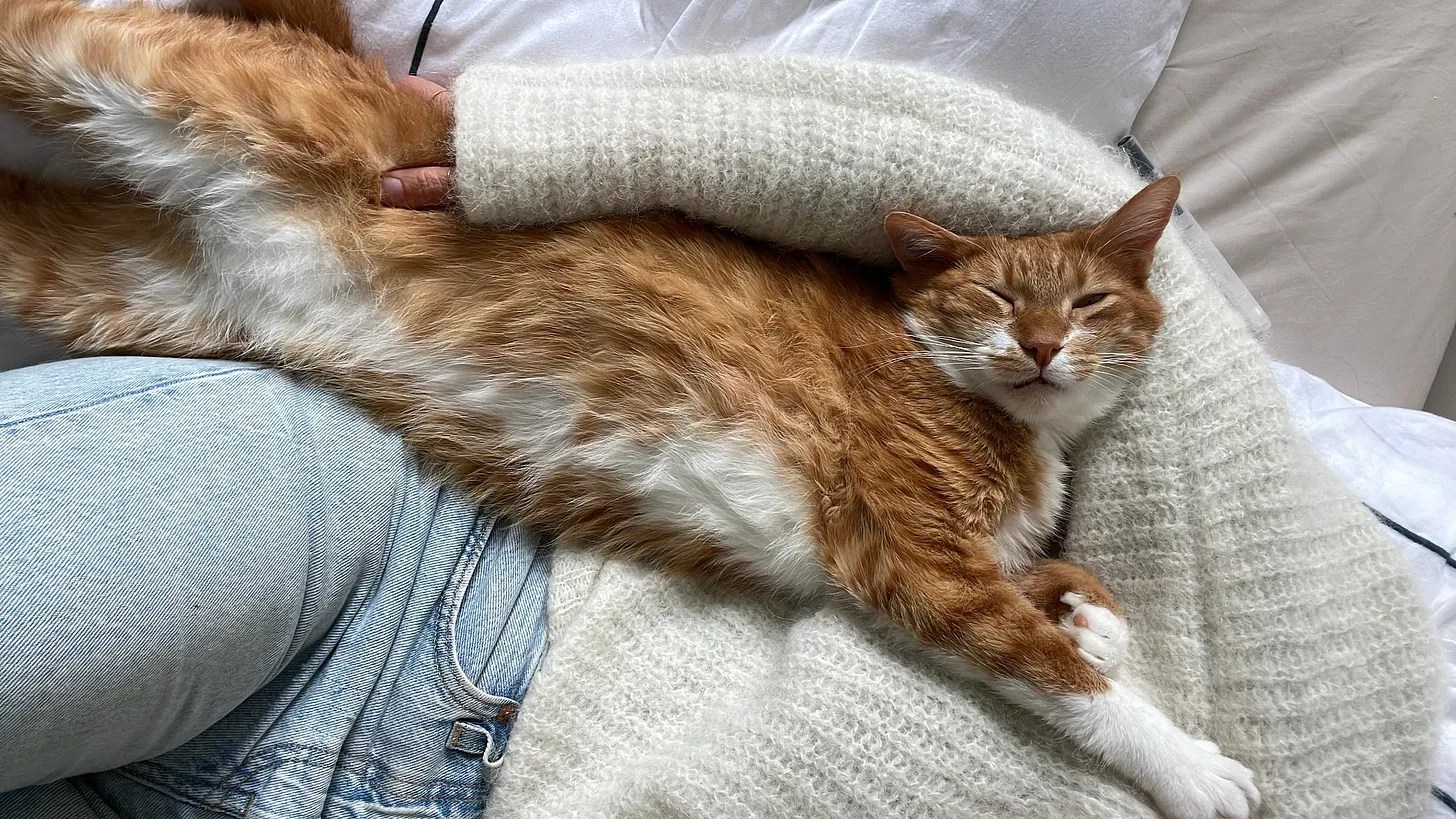
    Recently, it was moving continents. Leaving behind a life I built. Letting go of places, people, patterns that had once held me, and realising they no longer could. I said goodbye to my beloved cat, Danger-baby, with a grief so physical it felt like my chest had caved in. I packed my life into a few bags. I watched plans dissolve, relationships shift, and dreams turn to dust.

    It looks like trying to breathe through a kind of grief that doesn’t announce itself, because it doesn’t come from one loss, but many. Layered, silent, and unseen.

    There are days when I cannot find words. There are nights when the ache is so wide it feels like I am floating through it. There are moments where I forget who I had been, and haven’t yet glimpsed who I was becoming. I watched plans unravel. I watched myself unravel, too.

    Something deeper kept whispering. Keep going. Keep going.

    Beginning again requires a kind of surrender most people don’t talk about. The kind that comes when life has cleared the path for you. When you no longer have a choice except to let go of what was and place one unsteady foot in front of the other.

    I’ve always had a strange kind of love for these moments. 

    The ones where everything is uncertain. Because inside the wreckage, there is a rawness that is unmistakably alive. A freedom that only comes when the identities and routines and ideas that once defined us have been stripped away. There is something holy in the not knowing. Something exquisite in the beginning.

    Iit is not easy. It takes everything. 

    Emotionally, it asks you to stay present with the discomfort when every part of you wants to numb out or run. Psychologically, it demands that you examine the beliefs and patterns that built the old version of you and ask if you are still willing to carry them forward. Physically, it is exhausting. The body keeps the score. And the body also clears the slate.

    Last night, a heavy thunderstorm rolled in at dusk. The air, thick and electric, cracked open with light. Rain began to fall in sudden, urgent sheets, pounding against the windows like it had something to say. I was inside, barefoot and restless, watching it come down with a kind of reverence… that feeling you get when nature mirrors something stirring in you.

    Without thinking, I flung the door open and stepped outside. The water was cold and wild as it hit my skin. I stood there, arms loose by my sides, letting the rain drench me. I tilted my face to the sky and let it all fall. The noise, the wetness, the rush of it. My clothes clung to me. My heart beat hard in my chest. I imagined the rain washing away everything I had carried. The grief. The doubt. The heaviness of holding it all together. I didn’t need to make sense of it. I just wanted to feel clean. Emptied. New.

    There, in the twilight, in the storm, I remembered: this is how we begin. Not by thinking our way forward, but by surrendering to the forces that ask us to feel. To clear. To come back to the body. To let life touch us.

    Sometimes, beginning again looks like walking through the world in a daze, unsure of your name or direction. Sometimes it is lying on the floor, staring at the ceiling, convincing yourself that breathing is enough for now. Sometimes it is showing up to work or friendship or life, while something invisible inside you rearranges itself into a shape that can carry you forward.

    For the past two weeks, I couldn’t do much more than simply exist. 

    I pared life back to its most essential parts. Walks. Water. The sun on my skin. Gentle tasks. Stillness. I needed something to hold me that didn’t require words. Something I could lean on without having to explain myself. I remembered to turn towards rhythm. I anchored myself in the only thing that made sense: time. 

    Not the linear kind. Not the kind that pressures us to achieve or accelerate. The kind that follows the body. The cosmos. The planets. The pull of the week. The way each day carries a different tone, a different invitation, a different flavour of energy.

    This is what Planet Powered is made of.

    A lifeline. A way to gently orient myself to life again. To wake up and ask, “What does today want from me?” Monday is about movement and initiation. Tuesday helps me make decisions and take aligned action. Wednesday brings communication and connection. Thursday expands my vision. Friday reminds me to soften into love and beauty. Saturday returns me to my roots. And Sunday is the space to surrender and listen again.

    I created this, not just for me, but for you. 

    For the women who find themselves standing at the edge of a life that no longer fits, trying to hear what the future is whispering. For the ones who are not sure where to begin, but know they cannot stay where they are. For anyone who longs to be reminded that the pace of your life can follow the pace of your soul. That your days can hold meaning, even when everything feels uncertain. That rhythm can carry you when reason cannot.

    This is what I want you to know: nothing is wrong with you if your heart is aching. If the path is not clear. If you feel tired or tender or unsure. This is the precious work of becoming. There is a version of you that only emerges through this particular kind of fire. Not the kind that burns you down. The kind that refines you.

    You do not need a plan. You do not need to rush. You do not need to explain.

    You just need to be with what is here now. Let the rhythm hold you. Let the ache move through. Let yourself be remade.

    This is how we begin again.

    And if you’re craving a rhythm to hold you while you do, Planet Powered is here.

    It’s a guide, a practice, a gentle structure for your inner and outer life, rooted in the energy of the seven planetary days of the week. Beginning next Sunday, July 13th, we’ll move through it together — one day at a time — inside a live community space where I’ll share daily reflections, guidance, and invitations to anchor you into the energy of the day.

    If you’re in a threshold season — if you’re rebuilding, reimagining, or simply needing to remember your own rhythm — I’d love to walk with you.

    You can learn more and join us here: https://viendamaria.com/planet-powered/

    We begin again, together.

  • what I really think of nyc

    & why I’ve stayed…

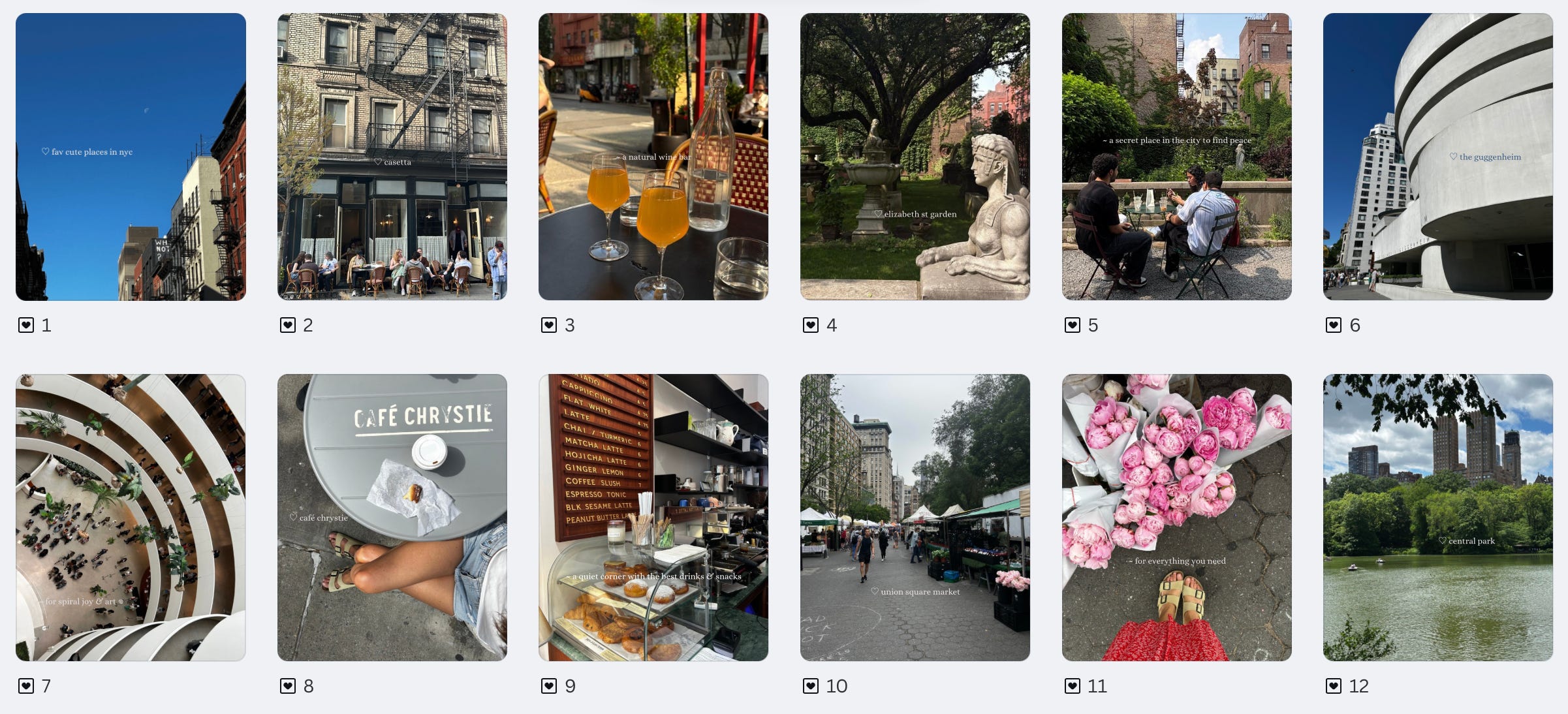
    find my list of fav cute places in nyc here on Instagram

    I heard a loud crunch, followed by the softest gasp, and turned my head. A bicycle lay on its side, a man tangled with it on the ground, and a large SUV hovered just above them, still and silent.

    In an instant, people moved. Without hesitation, strangers rushed forward, bending down, reaching out, offering presence and help. A small collision. A moment of disruption. And then, care. Simple, instinctive, human.

    That’s what New York is like. Sudden, raw, and full of heart.

    My friend Petra and I were sitting on the terrace of my favourite natural wine bar in LES when it happened, the fragility of human life, the compassionate human response brought tears to my eyes. In many ways, this encapsulates what I think of this city.


    People keep asking me “what were your first impressions?” and “did you actually even want to go?” and “what do you really think?” and “do you want to stay?” 

    New York holds you in ways you cannot hold yourself. It cradles you and asks you to let yourself be swept away by its momentum. If you cling to what you think you know and resist the current, it will spit you out. It is deeply imperfect. It is alive in a way that catches you off guard. There are layers to it, and not all of them are beautiful. You cannot escape yourself here. You meet yourself again and again. In the streets, in the faces, in the silence that exists between the sirens. 

    I think the New York that people fell in love with, the one that raised artists and misfits, the one pulsing with radical self-expression, is gone. Or at least fading. What remains is a softened echo. A diluted version wrapped in branding. You can still hear the heartbeat, but it’s muffled by rent prices and influencer cafés.

    I’ve seen this happen before. The cities stretch, and the soul thins. Creatives, thinkers, those who live at the edge of culture leave. No longer willing to mortgage their joy for the performance of a lifestyle. The New York I had hoped to meet doesn’t live here anymore. Or maybe she’s hiding. I don’t know.

    And still, the city pulls you in. There is something magnetic about the way life moves here. The pace makes you sharper. The people make you braver. Everyone is building something. Everyone is searching. 

    It has given me clarity. About what I want. About what matters.

    New York City retains a feverish optimism that anything is possible here. The American dream that you can create a new life on these shores remains intact and alive. The people cling to it, and this perspective offers opportunities to build on possibility and belief, if little substance. And that is enough. It is enough to start with. Substance comes with time.

    New York City hold the power of proximity. Most cities are built wide, so it takes an hour, if not more, to go anywhere. It is built sky-high, so everything is within half an hour’s reach, either walking or by Subway. It means you can meet people and go places without overly taxing both your energy and your time. The currency of this city is the value of your relationships. 

    That accessibility makes a huge difference.


    I came to New York for love. For adventure. For the desire to experience a different perspective and to reclaim my sense of inspiration and hope. I believed, deep in my bones, that the relationships I build shape everything that comes next. And for that, I couldn’t imagine a better place. 

    I also came to New York because I wasn’t sure where else to go.

    On Tuesday evening, I was supposed to board a flight to London, but I didn’t.

    Life cracked open in a way I didn’t see coming. Plans changed. The shape of my future shifted overnight. And so I stayed. Not because I wanted to, exactly, but because something asked me to meet it here, in the unknown, in the aftermath, in New York.


    hi friends!

    I felt like nodding my head at the fact that this newsletter is never just one thing. It’s part personal memoir, part story, part soul of my business. It contains multitudes, like I do, including updates and offerings, woven between reflections and real-life turning points. It arrives when it’s ready, not when a schedule demands it.

    Some weeks it’s a window into what I’m creating or learning. Other times it’s just a trace of where I’ve been or what’s breaking open in me. But always, it’s a long thread of my desire to be of service. To contribute something meaningful through words, through beauty, through whatever insights life offers me to pass on.

    I’m so grateful you’re here. That you let me do things this way. That you’ve never asked me to make my creative work more conventional, more predictable, more polished. Instead, you let me do it her way. And for that, I’m deeply glad. I’m working on an essay that reveals this business approach in depth because this is what I have discovered:

    Even though it’s really scary at first, it always pays off to do things your way. Even you think it’s wrong. Even when you think it’ll never work. Which is the underlying premise of her way club. To always trust yourself despite any doubt. 


    For the past months, I’ve been quietly working on something behind the scenes. A little companion guide I’ve been using in my own life for more than a decade. A way to ground, to find rhythm again, to work with the natural currents of time instead of pushing against them.

    It’s called Planet Powered…:for the curious

    Over the last few days, everything finally came together. The words, the flow, the feeling of it. It’s part written word, part gentle practice. A simple guide to living in rhythm with the energy of each day of the week. A way to tune back in, realign, and soften into how life wants to move through you.

    I’ll share more soon, but for now, I just wanted to let you know it’s here.

    And I hope it meets you exactly where you are.

  • what I did yesterday

    The task is simple and deceptively difficult: What did you do yesterday?

    We have always been curious about the lives of others.

    Long before television and tabloids, we craned our necks at windows, imagined stories behind closed doors. That impulse to know, to glimpse, to understand is ancient. We are, all of us, secret witnesses, seeking reflection, seeking difference, seeking the tender knowledge that we are not alone.

    “Ah,” we think, “so this is how another human moves through the day. How strange. How ordinary. How marvellous.”

    Most of us, if asked, would call our days unremarkable. We would point to the routines, the errands, the silences, and shrug. But presence alters the lens. What once seemed plain is suddenly flooded with texture:

    The amber glow of morning through the blinds.
    The brief pleasure of a spoon against the roof of the mouth.
    The idle reaching for a book, for a thought, for another hand.

    A life, it turns out, is made not of milestones, but of minutiae.

    It was this quiet revelation that shaped this week’s assignment in The Art of Noticing, the six-week writing club I am leading. The prompt is borrowed, with gratitude, from Aisling Marron of Notes From New York, who herself was inspired by a podcast of the same name.

    The task is simple and deceptively difficult: What did you do yesterday?

    No digressions. No rewinding or fast-forwarding. Only the bare, shining truth of a single day, as it unfolded.

    Here is mine:

    7:00am
    My boyfriend’s alarm goes off, the buzz slicing through the heavy fog of my sleep. I roll onto my side, eyes gritty, my head thick and stuffed with cotton wool. Regret clings to me immediately. Regret for the ambitious plans I agreed to, for not protecting the softness of this morning. But I am an adult and adults honour their commitments, so I climb down the ladder from our loft bed, bare feet pressing onto the cool wooden floor. I pull my aligners from my mouth, soak them in their cleaning agent, put the kettle on, and drop an ‘immune support’ Yogi tea bag into favourite mug. I find my tiny jar of Egyptian Magic and bring it and the tea to the sofa. My face aches, pulsing with the imprint of too-little sleep and the too-salty dinner from the night before. I settle into the cushions and begin to massage my lymph nodes slowly — chest, neck, jawline, cheeks, scalp — coaxing the fluid back into its pathways, feeling the swelling subside little by little. These small, tender rituals make me grateful for everything I’ve learned about how to tend to myself.

    7:30am
    My boyfriend finds me curled up on the sofa, kisses me. “How did you sleep?” he asks, and I reply “Fine”. I stretch my arms overhead and yawn, “The problem with making plans ahead of time is you never know how you’re going to feel when they arrive.” I splash warm water on my face, wipe off the leftover balm with a soft cloth, and brush my teeth, waking myself up bit by bit. He laughs and mixes creatine into two glasses of water — one for each of us. We sit shoulder-to-shoulder as I quickly scroll through my social apps, answering urgent messages and uploading the next The Art of Noticing lesson for my writing club. “Let’s go for coffee!” he suggests, and I peel myself away to dig through drawers in our little walk-in wardrobe, finding black leggings, a soft, sky-blue yoga tank, and my favourite Free People fleece that still smells of Portugal.

    8:15am
    As we descend the narrow staircase of our building, he tells me in hushed tones about how he heard someone fiddling with our lock in the night. A chill prickles up my spine; New York feels wild and unpredictable. We agree to tell the landlord, unsure how concerned we ought to be. Our favourite coffee shop is tucked just under our building, but he’s craving a vegan croissant, so we detour to Essex Market, the morning still crisp and pale. When we arrive, the market is shuttered, the gates still pulled down. Even New York, it seems, has its limits. By the time we return, the coffee shop has filled with people; there’s a queue spooled inside. We squeeze in, order two coffees and a few treats: a tahini cookie and oat cappuccino for him, a flat white and buttery croissant for me. I’m still hollow from yesterday’s hunger and bite into the pastry peeking out of the paper bag before the coffees arrive.

    9:00am
    I log onto Zoom for a meeting with an alumna from The Mentor Training. As we speak, my sluggish mind lifts into a higher orbit, buoyed by the energy of possibility. I remember — oh yes — I have built things, beautiful things. I have made worlds out of ideas. It’s so easy for me to forget, to always chase the next horizon without pausing to admire the view. Having it mirrored back to me reignites a quiet fire inside.

    9:45am
    We end the call with a plan and a few fresh objectives, and I scramble around our tiny LES apartment gathering keys and my phone, throwing back a glass of water before running to yoga class. I arrive breathless but just in time. The teacher welcomes me warmly: she’s tall, with a fluid grace, long stretchy limbs, and a soft accent that feels instantly soothing. She gestures for me to grab two blocks and a strap, and I find a space right at the front. A man plops down beside me at the last moment. Round-bellied, bald, but adorned in a pink ballerina-style outfit, bright red lipstick and nails to match. I smile to myself: we’re all girls here today.

    10:00am
    We begin on our backs, breath deepening, bodies sinking into the earth. The teacher’s style is light and casual, her voice weaving through the room like a ribbon. As we move into slow sun salutations, I feel the two decades of practice unfurling in my muscles, a familiar dance. Movement practices like yoga are an anchor for me, a home I can return to no matter how much the outer world shape-shifts. By the end of class, every inch of me feels stretched and rinsed clean. I thank the teacher quietly, wipe my mat with a lemon-scented towelette, and slide my Birkenstocks back on, feeling the earth a little closer beneath my feet.

    11:30am
    A 10-minute voice note from my bestie is waiting, so I pop my headphones in as I wander home, the city buzzing around me. I duck into a small beauty boutique and marvel at the rows of glass bottles and creams before finding my beloved Italian leave-in conditioner. $42, I am willing to invest in. As I browse, I send her a stream-of-consciousness voice reply, not to inform but to process; our sacred girlfriend ritual. It’s therapy in miniature, given and received without expectation.

    11:45am
    By the time I get home, I’m ravenous. I find my boyfriend deep in work at the tiny kitchen table and ask if he wants to share a picnic. He nods silently as I pull guacamole, purple corn chips, and baby carrots from the fridge. I slice tofu, arrange everything on a big plate, and pour coconut water into tall glasses. We carry it all to the coffee table and sit cross-legged, eating with our fingers and laughing about nothing in particular. I love how easy nourishment can be when it’s shared.

    12:30pm
    The shower is in the kitchen, a relic from the building’s pre-plumbing past. The hot water washes the morning away: tea-tree scented soap, a razor across my legs, a shampoo bar in my hair and afterwards my new leave-in conditioner combed through and coconut oil slathered on my skin with slow devotion. Fridays are for beauty, for romance, for the small Venusian acts of pleasure. I leave my hair to air dry, slip into shorts and a loose lounge top, and tidy the apartment, vacuum humming underfoot. I can’t sit down to work until my space feels clean and peaceful.

    1:00pm
    I curl into child’s pose on the sofa to write emails, tucked into myself. Eventually, my legs go numb, and I unfold with a sigh. I tick through admin tasks for The Mentor Training, refilling my water glass now and then. Around 3pm, I hand my boyfriend a glass too, scolding him lightly for not drinking enough. We giggle about something small and silly, and suddenly, at the same time, blurt out, “I love you.” He pulls me onto his lap, wrapping his arms around me tightly. “I love this,” he says, forehead against mine. “Working quietly together. Laughing. It’s precious.” I press my palm to his heart, and we both turn to admire the little pot of spring flowers blooming vibrantly in the window, as if blessing the day.

    4:40pm
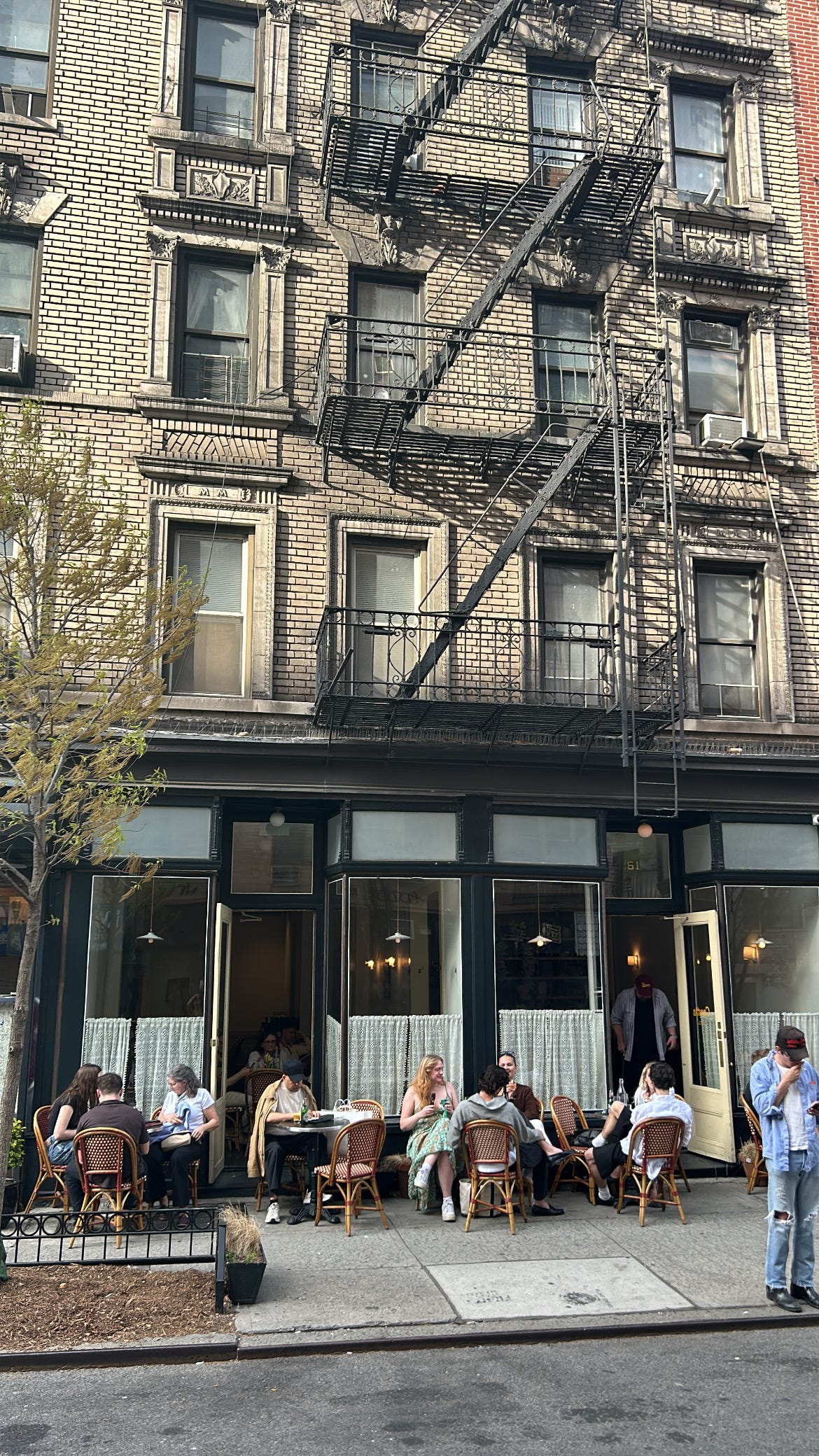
    He has plans to meet a friend at 5:00pm, and I decide to tag along, craving fresh air more than another minute of screen time. I waste most of my twenty-minute warning scrolling, then throw on a dress and sneakers, and wipe a lip tint on, and we’re out the door. We meet his friend at Essex Market and order drinks — matcha latte for me, iced decaf for them — and wander through the golden slant of late afternoon. I find myself distracted by the light bouncing off the buildings, the life vibrating in the streets. We wander through hidden galleries, a park filled with wildly competitive ping pong matches, and a tiny poodle who decides to befriend me. On a tucked-away corner, I discover Casetta, the sweetest wine bar, and instantly decide we must return for date night.

    Casetta

    6:00pm
    We stop at a market to pick up a baguette, some hummus, pico de gallo, and tiny, perfect avocados. Bread in NYC is standard stale (why?) but we take our bounty home for a second, casual picnic at the coffee table, layering pesto and arugula and salt on thick slices. We eat quickly, laughing and stealing bites from each other’s plates, knowing we have to leave soon for our night at the Whitney.

    7:50pm
    The Whitney is alive, packed with people, more than we expected. It’s a little overwhelming trying to see the art through the thick crowd. Still, some moments shine. I overhear a girl say to her boyfriend, “You have marathons, I have stairs,” as we climb to the rooftop, and I laugh in solidarity. And at the top the whole city stretched out in luminous twilight. He pulls me close, kisses me with a rare, wild tenderness, and I feel something invisible and important shift between us.

    8:45pm
    We meander back downtown through SoHo and into LES, the streets thick with nightlife now, music spilling out of bars and windows flung open. New York shape-shifts after dark, but I don’t feel the pull to join it. I feel full already — full of the day, of the hours stacked like soft, golden bricks inside me.

    9:30pm
    We tumble onto the sofa and watch the latest episode of Severance, my body warm and heavy with tiredness. Afterwards, I move through my nighttime rituals: wash my face, brush my teeth, click my aligners back in. We climb the ladder into our loft bed. He wraps himself around me protectively, and I sink into his warmth, into the safety of our tiny kingdom, asleep almost before my head touches the pillow.

    Was it a good day? (They always ask that on the pod.)

    Yes — it was an excellent day. A day stitched with small joys: pastries and coffee, sunshine on skin, a body stretched long and sweet in yoga, easy laughter shared across a tiny kitchen table, a museum kissed by sunset, the heavy, sore satisfaction of a life well-lived inside an ordinary Friday.

  • how I learned to put myself ‘out there’

    and let myself be seen. As a woman in the world who is a creator/writer/founder etc…

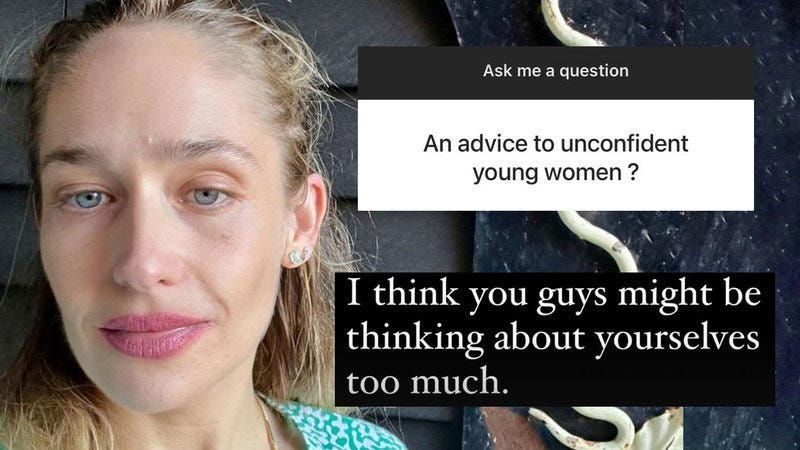
    Miss Jemima Kirk with the core wisdom

    To answer the title, how I did it is:

    I decentralised myself. I realised it’s not about me. It’s about every woman’s experience, waiting to be seen, heard, and shared…

    But let’s begin with today.

    At this very moment, I’m writing to roughly 10,000 eyeballs, the kind, curious readers who’ve joined me on this email list. On an average day, about half of you open these letters and video stories.

    In the 12 years I’ve been writing publicly, I’ve been met with so much kindness. One of my dearest friends is Japanese. Our friendship has lasted nearly two decades. She sent me a voice note this morning: “I’m so glad you write your stories and share them. You remind us about the sparkly parts of life. It’s a scary world out there. And you make it better.” She makes my world better too.

    There have been a few sharp replies over the years, comments that sting or arrive laced with judgment. I chalk them up to this simple truth: how someone responds to me tells me more about them than it does about me. This wisdom holds in every area of life. People are projecting what’s happening inside them, and remembering this makes compassion easier. Boundaries too.

    That’s the thing about putting yourself out there. You become a mirror. You invite people to see themselves in what you’ve shared. So it’s vital, imperative even, that you learn not to take it personally.

    Right now I’m sitting in Lisbon Airport’s Terminal 2, at the only café with tables and chairs. A group of French businessmen are packed in beside me, their conversation staccatoing into my ears as I finish this. A flight to Paris is next to board. 

    I started this piece over a week ago, knowing it would be the last chance to invite you to join me in the club.

    That’s often how my writing begins.

    I have an idea. I pick it up and write it down. Often I pop things in Notes 📝 because the thing will land just as I’m heading out the door. Or in the shower. Or on a walk. 

    Sometimes I’ll start a new page in Pages or Substack, type a few lines, give it a title I’ll recognise later, then leave it alone. I let the idea breathe. Sometimes I return to it. Sometimes I start again. I let things percolate until they’re ready. And when they are, the words come quickly.

    My boyfriend often says it looks like I can just sit down and write something fresh in an hour or two. And yes, sometimes I can. But what it looks like is rarely what it is. I spend all day every day, noticing. And that noticing forms thoughts, translated into words, becomes written.

    Most of my writing has been quietly forming in some hidden partition of my mind for days, weeks, even years. It’s been composting. Gathering weight. Waiting for the moment it wants to emerge.

    I remember a night, many years ago now, sitting cross-legged on the floor of my living room at 2 AM. Around me were teetering stacks of notebooks, filled with observations, essay fragments, and moments I’d never shared. Pages and pages that had never made it past my own eyes.

    I was always the friend who urged others to write publicly, to submit to journals, to start a blog, to hit post on Instagram. “Your voice matters,” I’d tell them. I meant it every time. Meanwhile, I kept my own work in the shadows.

    Every time my finger hovered over the “publish” button, a surge of anxiety would rise up. Who do I think I am? What if I reveal too much? What if it’s not good enough? What if it’s too much?

    And so, again and again, I saved instead of sending.

    I kept my words locked away in journals. Safe from judgment, yes. But also safe from connection.

    This quiet resistance followed me for years.

    What changed?

    One day I stopped making it about me.

    I realised I wasn’t writing for self-expression alone. I was writing to remind, to reflect, to connect. I was writing because somewhere, some woman, exhausted or elated or cracked open by life, might see herself in what I shared.

    The words weren’t mine to keep. They never were.

    And so I started thinking of my writing as a garden. Not a blog. Not a platform. A garden.

    A living archive of stories, insights, and scraps of beauty that others might stumble across when they need them most. Something worth wandering through. Something that grows.

    It helped to think of the silent readers, the ones who never hit reply or leave a comment, but who return again and again. I write for them too. You never know whose day or life your words are shifting, even if you never hear about it.

    If you’re building a body of work, this also matters. 

    Anyone considering working with you or publishing you will need to read your writing multiple times before they know if your voice is a fit. If your writing lives out in the open, they can find it. Trust it. Choose it. But if you only publish once every few moons, what are they choosing from?

    Your writing is not self-promotion.

    It is an offering. A window. A breadcrumb trail back to some deeper part of the human experience, for others and for yourself.

    Everything you’ve learned about shaping a sentence, translating emotion, and distilling clarity from the chaos of daily life is not meant to be hoarded. It’s meant to be shared.

    This matters more than ever.

    In a world increasingly flooded with synthetic, AI-generated words, human language crafted with care and shaped by hand becomes sacred again. This is the new counterculture, intimate, real, nuanced expression. Writing that makes someone feel less alone. Writing that notices. That names.

    So if you’ve been waiting to share something, a piece, a post, a half-formed thought in your Notes app, consider this your gentle nudge.

    ~ Write for the version of you who once needed the words you now carry.

    ~ Write for the person out there who’s waiting to feel understood.

    ~ Write even if it’s quiet. Especially then.

    ~ Your writing might be exactly the permission someone else needs.

    Your voice is not the point, but it is the portal.

  • today, I have three weeks left here

    a personal update and an invitation

    The morning sun is drawing lines across the wooden floor and the cheap white Ikea rug. From the bedroom, I can hear my boyfriend’s soft snores. Further down the hall, the washing machine is whirring with his dirty clothes. 

    I snuck out of bed an hour ago. Love is to let him sleep in peace when I am restless and full of words that want to pour out of fingertips. Love is to want his clean clothes to be hung out to dry while the sun is still out after weeks of deluge.

    When I got up I pulled on my £4 vintage Pink Floyd sweater that layed crumpled on the floor and picked up my laptop to hug to my lap while I lay on the sofa and write. 

    Now that I am here the many things I had wanted to put down evade me asking to be rearranged in my mind, to find a storyline, a thread to hold them together.

    Two weeks ago we were in London. The day we arrived it was sunnier and warmer than in Portugal where we had come from, and we walked from London Bridge to Colombia Road Flower Market. A favourite ritul of mine, to meet one of my best friends and drink coffee and eat crossaints and hear the flower sellers shout their prices. 

    Twenty years earlier when I lived in Hackney I’d go every weekend. Back then the streets were shabbier, speciality coffee shops did not yet exist, and you could buy bouquets of flowers at ‘two for a fiver’. (Imagine that in an East London cockney accent.)

    We were in London to renew my passport due to an inexplicable bureaucratic quirk: the Austrian embassy in London would accept the very paperwork that the Passport Office in Austria had rejected when I’d flown there weeks earlier.

    I often joke that I thrive at the fringes of existence, belonging nowhere in particular, my official residence a mystery even to myself. An inconvenience only once every 10 years: when I need to get my passport renewed.

    When I think about it London is the closest thing I have to a home. It’s the place I have resided in most often in my adult life. It’s the only country where the passport control officer says “welcome home” when I pass through. It melts my heart a little.

    On our last morning we ate cinnamon buns in Sloane Square cutting through the pillowy sweetness with sips of bitter coffee. Standing in a slice of sun pouring between buildings we watched the corporate working world rustle and bustle their ways into their offices. 

    When I stand and observe mass humanity as I did that morning, I’m struck by the humbling realisation that each hurried figure represents an entire universe of hopes and struggles. 

    Strangers — clutching coffee cups, checking watches, muttering into phones — all orchestrating their complicated lives with the same earnestness I bring to mine. At the core of each life, beneath the professional veneers and morning routines, pulses the same fundamental need for connection and meaning. 

    Love, in its countless expressions, remains the gravitational center around which we orbit. This truth makes the artificial structures we’ve built — the endless pursuit of productivity, status, and material gain — seem profoundly misaligned with what actually sustains us. 

    The day after we returned, my friend Hannah arrived like a gift. 

    After weeks of relentless rain drumming against windows and seeping into spirits, the clouds parted. For two precious days, we traced paths along the wild, rugged coastline that embraces the little village I’ve called home since autumn. 

    The sea air carried the scent of salt and possibility as we navigated rocky outcroppings and windswept bluffs, our conversations flowing as naturally as the waves below. 

    This landscape, in its raw, untamed ways, has become my sanctuary. Despite an unexpectedly brutal winter — longer, wetter, and colder than I had prepared for — I’ve made it my ritual to seek out nature’s company whenever possible, finding in its rhythms a counterbalance to life’s uncertainties and a reminder of what endures.

    Today, I have three weeks left here.

    The past two days we, and two friends, helped my boyfriend dismantle the home he has inhabited for four years. Box by box. Bag by bag. We hauled his life down flights of stairs. Until nothing remained. On Friday, he leaves with just a 40-litre backpack. Nothing else. 

    His devotion to non-attachment is both inspiring and daunting. I’ve promised to follow with carry-on luggage, but I can’t match his minimalism. Some outfits and useful treasures must join me in my journey. 

    I’ll document this bittersweet sorting soon.

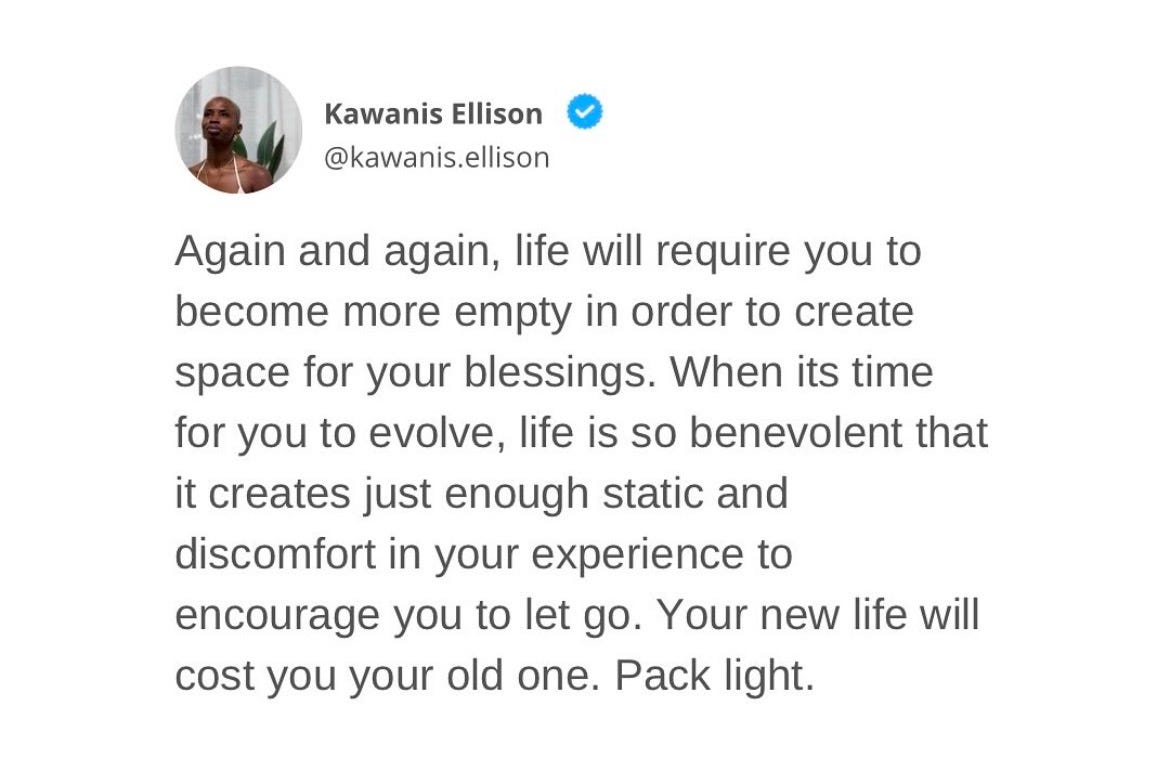
    My deepest heartache is leaving my cat behind. I scroll through our six years together and grief floods my body. There’s wisdom in the saying “your new life will cost you your old one,” but knowing this truth doesn’t soften its sharp edges. 

    I had found what seemed a perfect family for him, but their recent hesitation has sent me into a desperate search for someone who will cherish him with the same devotion I’ve offered. He has been the steady heartbeat at the centre of my existence; love incarnate in fur and purrs. This is the most painful sacrifice I’ve made in years.

    But there is a new life waiting for me out there. I expect the energy of New York to lift me up and reinspire parts of me that have gone to sleep. I anticipate the world showing me what is possible for me in a way that I had not known.

    And with all of this I have had to shed various versions and identities of myself that I had created. Many of them more self-protection than authentic. I am learning to let go of them to be replaced by something new, alive, real, responsive. 

    A huge piece of my growth recently has been learning to observe, not absorb.

    I’ve promised myself I am finally going to start writing a book. Starting on the flight to New York.

    Cringe! I hate even writing that. 

    My biggest fear is that I’ll start and never finish. Or that I’ll say I am going to write a book and not do it. But I promised myself I would and I try to always keep my promises to myself.

    I’ll write for an hour each day—morning or night. Whatever emerges. These words, unlike my private journal entries, are meant for strangers’ eyes. Same practice, new purpose.

    Then I thought: What if we wrote together? 

    A group of writers: would-be/could-be/want-to-be established, aspiring, curious writers and we all wrote together.

    Every day. For 6 weeks.

    Not necessarily an hour. Maybe 10 minutes for you. A sentence. A page. A journal entry. A poem. Whatever meets you at your edge.

    I’ll help you find your achievable aim.

    Science says 21 days forms a habit. We’ll do twice that. Together.

    so, 
    let me invite you to: 
    the art of noticing ~ a 6-week writing club 📝

    Come write with me, every day, for 6 weeks:

    learn more & join

    There are creaks coming from the bedroom. My boyfriend must be waking up now. The morning sun has shifted, no longer drawing lines but flooding the room with golden light. The words I’ve poured onto this page can go and live their own lives out in the world now. 

    Observations are made in the living, not the writing.

    I close my laptop and set it aside. The washing machine has gone quiet; I’ll hang his clothes in the sun. In a moment, he’ll emerge from the bedroom, hair tousled with sleep, and we’ll begin our final Sunday ritual in this place that has been, however briefly, our home.

    The thread I was searching for earlier reveals itself. Love is the storyline that holds everything together.

  • enough

    my life of “it’s enough” instead of “I want more”

    We’ve swallowed the lie whole. It’s in our bones now.

    Our egos have been programmed into the structure.

    This relentless pursuit of more. Always more. Your benchmark keeps changing. You never reach the finish line. The wanting never ends.

    In this capitalist world that constantly whispers “more, more, more”, standing still and saying “I have enough” feels like a rebellion. A quiet revolution of the soul.

    At a party given by a billionaire on Shelter Island, Kurt Vonnegut informs his pal, Joseph Heller, that their host, a hedge fund manager, had made more money in a single day than Heller had earned from his wildly popular novel Catch-22 over its whole history.

    Heller responds, “Yes, but I have something he will never have — enough.”

    enough kms/steps walked

    enough friendships

    enough discipline

    enough money

    enough clothes

    enough love

    enough joy

    enough

    There is a certain magic in embracing enough.

    It’s the moment you stop struggling against the current and simply float. Suddenly, you realise the river’s been carrying you all along.

    As we meet mid-year, I’m learning to trust in the existing abundance.

    I’m tuning into the rhythm of sufficiency that beats in every cell of my body. It’s a gentle pulse that says, “You are enough. You have enough. This moment is enough.”

    In the soft light of dawn, in the quiet moments between breaths, in the space between thoughts — that’s where I’m finding my enough. It’s not a destination, but a way of being — a lens through which to view the world.

    A life of abundance disguised as simplicity. A life of richness measured not in things, but in moments. A life of recognising that the cup isn’t half full or half empty – it’s overflowing, if only we have eyes to see it.

    In this noisy world that’s always clamouring for more, let’s be the ones who dare to whisper “enough”. Let’s be the ones who find infinity in a grain of sand, and eternity in a wildflower.

    Because when we know we are enough, we have enough, we do enough – that’s when we truly begin to live.

    A THOUGHT EXERCISE:

    Make a practice of writing your list of enough.

    Not could it be 10x better – but does it feel in your heart like enough?

    * Family — Enough

    * Friends — Enough

    * Home — Enough

    * Work — Enough

    * Partner — Enough

    * Mentors — Enough

    * Memories — Enough

    * Blessings — Enough

    * Recognition — Enough

    * Opportunities — Enough

    * Financial independence — Enough

  • life > screens; + boundary tips

    how I taught myself to have boundaries with screen time to reclaim my life

    I am sitting on my bed in my cabin, a cup of tea balanced on my plannher beside me, my cat Danger Zone nuzzled onto my right arm hindering access to the keys as I tap these words to you. I’ve had a morning of private clients on Zoom, was on Instagram, in the name of marketing and now am writing you an email. A delightful form of intimate connection tapped out via Substack.

    Everything I have done so far today has happened on screens.

    In retrospect, we see what this journey of life really is.

    What it was made up of.

    In retrospect, we see that our whole life is made up of choices, one after another, in the name of love and connection.

    Self-employment is an incredible privilege. I started on this path because I instinctively refused to join the 9-5 grind. It can also be incredibly overwhelming and (very) lonely. Little did I know that a few years along my work would end up being mostly behind a screen.

    I work about 20-25 hours weekly in and on my businesses.

    Every single one of those hours is spent on a screen.

    One thing I don’t want is to look back and regret how much time I spent on screens instead of existing in the living, breathing world around me.

    Technology is wonderful in so many ways. It offers me a way to contribute to society that is both meaningful and creative, on my terms. My life is (mostly) my own with the efficient ease of having communication, connection and organisation tools housed in a magical cloud in the sky.

    I spend an average of 4-6 hours on screens per day. That includes using meditation apps, music apps, map apps, banking apps, notes apps, workout platforms and apps that help me in my business.

    But if I’m honest, much of that time is spent on Instagram, WhatsApp, and search engines.

    Yet.

    Many of us strongly desire to withdraw from the outward-facing parts of life… hence the move away from screens and social media. It’s about reconnecting inwards. Allowing ourselves to feel what wants to come through us. This means that we’re no longer focused on the external noise but rather on the internal guidance.

    But the world that we exist in does not allow this descent. Going inwards requires slowing down.

    Slowing down is very hard in a world built on fast consumption.

    It is incredibly rebellious to slow down in this world and yet… this is the only way the only place where we can find ourselves. To reconnect to those parts of ourselves that are yearning to be heard. That is here with us, beside us every step of the way; that we often remain disconnected from.

    We take those moments in, in tiny sips but never fully bitten into, absorbed, inhaled, made use of. This richness and depth that is available to us all the time is accessible only through slowing down.

    But screens.

    They blink and flash and move fast and catch our eyes. They elevate our adrenaline, activate our dopamine and make us think that life is supposed to feel extremely exciting all the time. They impact our circadian rhythms and stop us from sleeping well and deeply resting when we need to. They suck us into a spiral of trying to keep up with ‘fast and now and more’.

    When what we really seeking is love and connection.

    Here is how I taught myself to have boundaries with screen time to reclaim my life.

    1. I fill conceivable screen time with a different form of connection. I make it a priority to spend time with friends, go out in nature, read books, cuddle my cat, go to gigs and events with other living breathing humans, travel, paint, draw, dream and journal. It’s so easy in moments of loneliness to get on a screen and spiral. I ensure that I have enough heart-nourishing things happening in my life that I don’t have to.
    2. I have a phone-free morning routine. It’s so easy to pick up my phone first thing when I first wake up. Just in case someone I love got in touch! I often think to myself. But the ripple effect of putting a device before my human self is palpable throughout the day. Instead, I leave my phone where it is in another space or room, and spend the first half an hour at least, waking up, stretching, taking my retainers out, scraping my tongue, making warm water with lemon, doing a little lymphatic drainage massage or a meditation, before I go anywhere near that thing.
    3. I have a phone-free evening routine. I am very strict with myself on this one because it’s easy to get devoured into a sea of I’ll just look up this one last thing, when I am tired in the evenings. Instead, I place my phone on aeroplane mode, put it to charge as far from reach as possible and spend half an hour to an hour alone with just myself and my thoughts.
    4. I use an app to monitor screen time. I use and recommend Opal, which I love both aesthetically and because it seems to kick me off whatever app I am using at just the right time as if it can sense when I’ve been overdoing it. It is crazy to me how lost I can get in the void of apps and on-screen productivity. These things were supposed to give us more time and ultimately they are stealing our time unless we reclaim it.
    5. I consistently delete certain apps. Instagram in particular, because it’s my strongest draw to get lost in. Even if just for a few days, but sometimes for weeks or more, what a relief it is for that app to disappear from my phone. Every few weeks I go through my phone and cull apps: ones I rarely use and ones I use too much and need a break from.
    6. I minimise my ‘follow’ list. A sure way to stop myself from scrolling is running out of things to scroll so I maintain a very small list that is focused only on necessary work-related connections, friends I can only connect with in this way, and accounts that inspire me to be a better human.
    7. I set limits on how much time I spend on screens. One of my highest values is presence. Something that I practice in every area of my life. If I am on a screen — unless I am with a client, writing, answering emails, or designing a new project — I am not present. I have a strong pact with myself to keep my phone tucked away when I am with other people. I try to have certain windows during which I use social media. I take photos in moments and believe that not everything needs to be documented.
    8. I intentionally cultivate a life that is more than screens. I leave my phone behind whenever I can. I put my phone in inconvenient places so I can focus on the task at hand. I spend time in parts of the world that don’t have an internet connection. I find peace there. It’s not perfect. It’s a work in progress. Eventually, I would love to exist in a way where I am not using my phone more than a few hours per day. And sometimes not at all for stretches of days and weeks. Right here and now that’s not entirely possible. I am doing my best.

    These implementations are probably things you’ve already heard of. They’re not mind-blowing or new. But doing them is a whole other story. They require self-control, structure, boundaries and communicating with your people when you are available and when you are not.

    Research can’t keep up with the pace of technological innovation. And being human is pretty complex. But what we do know is how spending time on screens makes each of us feel.

    I know that when I hit my limit my body starts to feel ungrounded and anxious. That limit is around 4-5 hours. When I have boundaries on my screen time, I benefit from more joy, more creativity, more positive thoughts and more real-life human connections.

  • everything I know about how to write…

    I learned from other writers and from writing for hundreds of hours. Here are 10 tips that have helped me become a better writer.

    I don’t know what I think until I write it down. — Joan Didion

    When I first read those words I finally understood why I write. It gives me pause. I need to be a witness to my life, my feelings and my processes. Unlike some, who move through life with a continuous external monologue, I internalise everything and have to allow it to move through my body, to my mind and then out of my fingers to make sense of it.

    At first, I only ever wrote for myself. Notebooks of blank pages that became illustrated by the stories, musings, heartbreaks, growth and challenges of my life.

    When I started travelling in my early 20s, before social media, I had a Hotmail email account and would collect email addresses from the people I connected with, sharing musings through the lens of my perspective in a group email to all my contacts every month.

    It was like the original Substack or newsletter.

    One day a man I had met on one of my trips to India who read those emails told me I should start a blog, an idea I resisted, at first, but then embraced. It was 2012 and what else was there to do on the internet?!

    At first, those articles were rough broad strokes of bland writing but with experimentation and practice, I slowly started to find a way to tell my stories.

    Here are 10 tips I have learned from prolific writers about writing.

    1. When you write, write to ONE person. Remember that on the other side of every screen, article, email, social media post or book, is just ONE person. Decide who they are, and write to them. I like to imagine I am writing to a close friend. Someone who knows me, that I can trust, and feel safe to be vulnerable and honest with. Because that’s what I want that ONE person on the other side of my writing to feel. That person is YOU.
    2. Be as micro-oriented and detailed as possible. Notice the difference between: ‘It is raining.’ and ‘The soggy smell of fresh rain on a warm summer evening is drifting up into the second-story window as I lay on my bed typing these words.
    3. Brevity is beautiful. This means say as much as you can with the least amount of words and keep sentences radically simple. I often go back through my writing before I press send or publish and take out as much as I can, simplify as much as I can, with my focus on the message being potent and emotive.
    4. Start at the beginning, write what happened, what it looked like, how it felt, and keep going until you get to the end. Then go back and edit it for flow and fluency.
    5. Remember that the entire world hinges on storytelling. Don’t tell people what they should or shouldn’t do. Don’t explain your points. Tell your stories and allow those stories to speak for themselves. Your reader will take exactly what they need from that.
    6. Write often and write in various formats. I write every day. I journal for myself. I write business emails. I write poems. I write single-sentence prose saved in the notes app on my phone. I write idea lists. I write articles. I write stories. I write newsletters. Writing lends itself to more writing. If you want to write, write.
    7. Read. Read whatever you feel drawn to. Read whatever you enjoy reading. Not only will it expand your vocabulary and grammar but it will give you different perspectives on how to write. Some of my favourite examples of very different styles of writing that inspire me are ‘Circe’ by Madeleine Miller, ‘The Chronology of Water’ by Lidia Yuknavitch, and ‘Sand Talk: How Indigenous Thinking Can Save the World’ by Tyson Yunkaporta.
    8. Your life, your experiences and your unique perspective are fascinating. Don’t withhold that from the world. If there is something inside you that compels you to write, please, write. For all of us. Even if we never get to read it. Having your words drift into the ether of our cosmic universe is a gift in itself.
    9. There are no rules. You get to write in the way, the length, the prose, the rhythm and the style that feels most you, to you. That’s what is going to bring your gifts out of you. Just write in the way that it pours through you.
    10. You will not always love your writing. Keep writing anyway.


    Here are some of my best reading recommendations:

    5 fiction books that changed me

    my summer 2021 ‘best of’ reading list

    9 books I read (+ loved) during lockdown

    8 ridiculously awesome + useful books + resources you will love

    5 latest books that have made me feel empowered, alive and vibrant

    Enjoy!