Category: inner space

  • life design

    7/8 — the seventh rule of her way club (aka: how to change your life in 6-12 months)

    OCT 26, 2025

    Continuing our 8 rules of her way club series. If you’re just joining, begin here:

    1/8 — deciding to play by your own rules
    2/8 — subtracting what doesn’t belong
    3/8 — the natural consequence: uncertainty
    interlude — her way deep rest
    4/8
     — trust yourself
    5/8 — inner life
    6/8 — outer life
    7/8 — life design
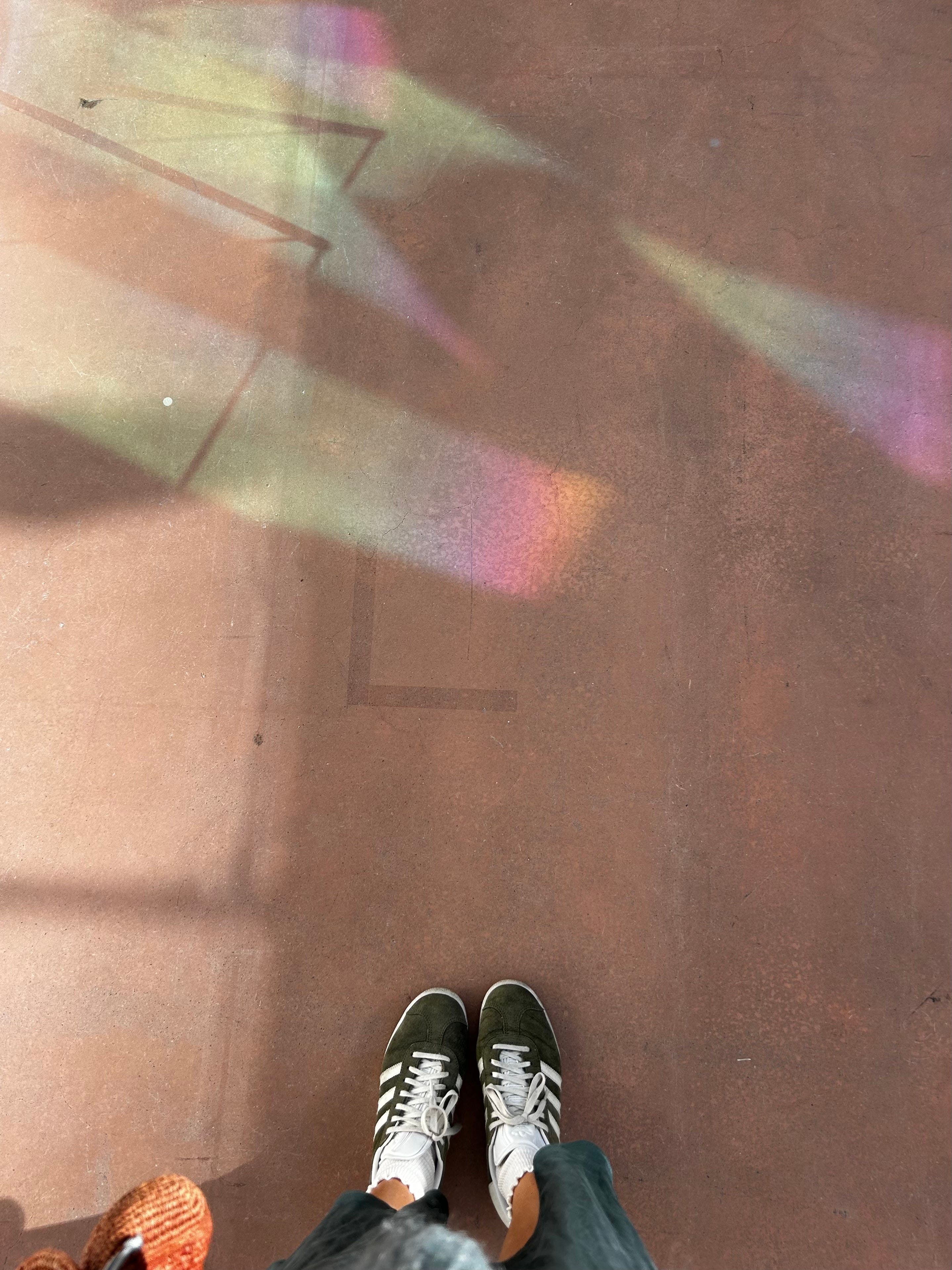
    at Art Basel Paris 2025 yesterday, predictably admiring the way the light hits the floor, which is not technically part of the art exhibition

    This week, I am tired. The kind of fatigue that comes when your nervous system finally gets permission to stop holding it all together. After months of spinning my wheels, leaving New York, hovering in uncertainty about where and when I would land, it finally happened. 

    I found an apartment in Paris. A frantic search, hopeful messages that went unanswered, some near-misses and a false start later, I moved in. The first week disappeared in a blur of unpacking and catching up on everything that had been urgent and waiting. Work deadlines, emails, small domestic details like finding where to buy detergent. I needed to land and find my pace again: a work rhythm, a home rhythm, a sense of myself inside this new city. And all of it caught up with me.

    By Thursday, I was dragging myself from one meeting to the next, still pretending I wasn’t running on fumes. On Friday, I tried to fill my creative cup by going to Art Basel with a new friend. It was beautiful, but after a few hours I felt overstimulated, so I went home. I started watching the first season of Andor with my headphones on while epilating my legs and underarms, reclaiming my body from the world. I showered, moisturised, and climbed into bed by seven. An exhale I’d been holding for months.

    Even in my exhaustion, I am still delighted by the smallest things: the washing machine in my apartment (a luxury after nyc), waking up and looking out of my cliché Parisian window to see the opposite windows and rooftops, hearing the hum of the city around me. I love working on my own schedule and earning a living doing work I love and believe in.

    Which brings me to the seventh rule of Her Way Clublife design.

    You are always creating your life. Every thought, every choice, every habit is a creative act. The only difference between those who create consciously and those who don’t is awareness. When you bring what has been unconscious into the light, your creativity becomes aligned: with truth, with pleasure, with peace, with purpose.

    I have created a life that I am genuinely proud of. Through hundreds of small, intentional choices. The life I live now was once just an idea I was shaping: the slow mornings, the freedom to work from anywhere, the ability to follow my seasons instead of forcing myself into someone else’s timeline. My days are simple and full. I wake up slowly, make tea, open the windows to let in air and sound, and write until noon. I take long walks, meet friends, make time for art and beauty, and rest when I need to. This too is work: tending to the inner soil from which all creation grows.

    I no longer have to start over every time I change cities or a relationship ends. My sense of security lives inside me. And even while I appreciate what I have created, I am working quietly, diligently to create the next version of my life, the one that will meet the woman I am becoming. 

    To firstly change and secondly consciously create your life, your personal ideal lifestyle comes first. It means that before you make a decision that could impact your future, you consult with your ideal lifestyle.

    ask yourself

    I often have to ask myself, “Is this the life I actually want to live?”

    Sometimes the answer is no. And when it is I have to adjust. Sometimes I realise I’ve been tempted by dreams and goals that belong to someone else, or I’ve slipped into the comfort of pre-worn tracks, or let social expectations quietly steer me away from what’s truly mine. When that happens, I have to stop and reset my life.

    For me, one of life’s greatest luxuries is having the space and time to respond to life in a present, intuitive, moment-to-moment way. It means choosing to operate from a place of spaciousness. For that to be possible, I need to have control over how and where I spend my time. Which means I cannot be beholden to others for my income, environment, or energy.

    I share this as an example because it’s true for me, but that doesn’t make it true for you. Across the past six “rules” in this series, I’ve planted seeds for you to begin identifying your own truth. So you can start making decisions about the kind of life you actually want. Maybe some of what I share resonates. Pick out the parts that do. 

    I encourage you to spend time thinking about what your ideal lifestyle feels like and to reverse-engineer it from there.

    create your lifestyle

    Here’s a simple exercise to start clarifying your ideal lifestyle and bridging the gap between where you are now and where you want to go.

    1. Get a large piece of blank paper and a pen.
      A4 will do. That’s usually what I have lying around. Turn it horizontally so the long edge faces up, and draw two lines down the page to divide it into three parts. This doesn’t have to be perfect; you’re creating clarity, not art. (Though if you love beauty like I do, you can turn it into something beautiful later.)
    2. Title each section:
      • Left third: NOW
      • Middle: LEAP
      • Right third: IDEAL LIFESTYLE
    3. Begin at the end.
      Under IDEAL LIFESTYLE, write in detail what your ideal life looks and feels like.
      • How do you feel in your body?
      • How do you like? Body? Style? Image?
      • How do you begin your day?
      • What do you spend your time doing?
      • Where is your focus and attention? 
      • How do you contribute to the world?
      • What do you receive from the world?
      • How do you sleep, and with whom?
      • What is your financial situation?
      • What are your relationships like?
      • Who do you spend time with?
      • What do you love?
      • How does a day, a week, and a month flow for you?
      • Add anything else you can think of that you want to include here…
    4. Then return to the beginning.
      Under NOW, answer those same questions honestly. What does your current lifestyle look like? Where are you out of alignment? Where are you pretending? Be detailed and ruthless in this process, but also kind. This is a moment of radical integrity, not self-judgment.

    Pause now.
    Before your LEAP, you may need a break. It takes strength, courage, and energy to choose the path of radical self-responsibility. You are on the path of becoming a creator, which is the final rule of her way club. This is the time to practice self-compassion. Be generous with yourself. Forgive the versions of you who made choices that weren’t true or kind. We are all doing our best. Now, you have the chance to realign and do better.

    life design

    Now ask yourself: What needs to change for my life to truly be my own?

    1. Go to the middle section of your page: LEAP.This is where you close the gap between where you are now and the life you’re consciously creating. Identify what shifts need to happen, both internally and externally, for your days and life to begin reflecting your truth. This is where you close the gap between where you are now and the life you are creating for yourself.

    I have become quite clear on my ideal lifestyle over the years.

    I want to wake up naturally without an alarm — usually between seven and eight am — and drink a cup of tea in bed while looking out the window. I spend two to four hours writing, then get dressed in something that makes me feel gorgeous. I go on walks, meet new people, explore new places, wander through flea and farmers markets, take an exercise class, read new books, build creative projects, eat fresh, local food, watch live music, go dancing, laugh with people I love, go to sleep when I’m tired, and generally feel creative, grateful, inspired, beautiful, and alive.

    When that lifestyle is maintained, my mind, body, spirit, and business continue their natural process of evolution and growth becasue they are held by a container of a life that is authentic and feels good to me. When we create the conditions of a good life, nothing but a good life can flourish from there.

    Life design is not about having everything figured out or seeing the whole picture. It’s about stepping into the knowing that you are the author of your own life experience, that your choices, beliefs, and perspectives shape your world, and that by taking ownership of them, you begin to live with intention, clarity, and alignment.
  • outer life

    6/8 — the sixth rule of her way club (aka: how to change your life in 6-12 months)

    OCT 15, 2025

    Continuing our 8 rules of her way club series. If you’re just joining, begin here:

    1/8 — deciding to play by your own rules
    2/8 — subtracting what doesn’t belong
    3/8 — the natural consequence: uncertainty
    interlude — her way deep rest
    4/8
     — trust yourself
    5/8 — inner life
    6/8 — outer life


    Before we continue, 2 important things:

    1. Next week, starting on Tuesday with the New Moon 🌚, I am gathering a small circle of writers and dreamers for six weeks of writing together for The Art of Noticing. I’d love you to join me. Doors close on Saturday at midnight. Join here.
    2. Please continue completing this questionnaire. The competition ends at the end of this week. If you haven’t completed it yet (and you’d like the gift of working with me 1:1), please, do so here.

    Life changes in an instant. The ordinary instant. You choose a new way to view your life, and suddenly it takes on an entirely new flavour and trajectory.

    I remember the day that I decided to devote myself to living a life that is truly my own. I was living in Venice, just a couple of blocks back from the beach in Los Angeles. It was a sparkly late September afternoon, the sun in that part of the world a generous haze that fractures the light, scattering it in such a way that there are no shadows. I had just come home from a date with a curly-haired actor who lived in a garage and was delusionally committed to his acting career. If he can be so devoted to his dream, so can I, I decided.

    My dream was not anchored in what my life would look like, but how it would feel.

    I want a life that feels soul-led, heart-driven, alive, romantic, bohemian, and rich. I want a life that, if at any given moment it comes to an end, every moment of it was well-lived and full.

    On that afternoon in Venice, I surrendered my motivation for curating a life that looks good on the outside for a devotion to one that feels good on the inside. And to allow my outer life to be a co-creation between me and a higher power based on my inner life and essence.

    At first intentionally, and more recently, with a stronger desire to find my place, I have been moving between cities and countries, following the rhythm of my life and the quiet pull of my work. I don’t have a dedicated office or a desk that anchors me, but I have something far more powerful: a dedication to my expression and my work and as an extension of both, to my writing that exists in my mind, in my days, and in the life I’ve intentionally crafted. 

    On some mornings, I write in a sunlit café overlooking cobbled streets; on others, in a small apartment with the hum of a city below me. Sometimes, I’m sitting cross-legged on a patch of grass under a tree, letting my notes scatter into the wind. The space itself is secondary. What matters is the commitment, the devotion, and the intentionality I bring to it.

    This is what outer life is really about: creating the conditions for your inner world to find expression.


    The first five steps of this series built the internal architecture for this moment. 

    You’ve taken back your power, carved space for yourself, leaned into uncertainty, trusted your instincts, and begun tending your inner life. Now, all of that work begins to take shape. This is where the choices you make daily, deliberately, insistently, start to build a life that reflects your authentic self. 

    You must understand this: your outer life is a reflection of your inner life. The more intimately you know yourself, the more consciously you can build the world around you.

    Outer life can be divided into three intertwined arenas: belonging, contribution, and life design. Each is a reflection of the inner work you’ve done. Each requires courage, curiosity, and clarity.

    belonging

    Belonging is one of the quietest, yet most vital parts of your outer life. It is about the subtle, soul-deep resonance that occurs when you are seen and reflected in ways that align with your inner self. 

    There is a paradox here: authentic connection requires both discernment and vulnerability. You must choose wisely, noticing who nourishes your essence and who depletes it, and yet you must remain open, willing to reveal your true self even when it feels risky.

    I learned this while building my life across cities, coasting between cafés, shared apartments, and rented studios. Some friendships, no matter how long or familiar, feel heavy. They pull on my energy, asking for parts of me that I am no longer willing to give. Others, sometimes newly formed or unconventional, carried me and lifted me higher. Conversations sparked ideas, laughter became inspiration, collaboration became growth. I had to learn to notice the difference, to audit not only who was present in my life but how their presence made me feel in my body, mind, and spirit.

    You started this practice in rule 2: subtraction. Take stock of the relationships you have: colleagues, friends, family, collaborators. Ask yourself, who energises me? Who inspires curiosity, excitement, and possibility? Who mirrors the essence you’ve begun cultivating through your inner work? Then notice the opposite: who consistently drains, frustrates, or diminishes your energy? The goal isn’t to cut everyone away or to judge harshly, but to become conscious of how your interactions affect your alignment.

    Once you’ve mapped it, create space for the relationships that resonate and set gentle but firm boundaries with those that don’t. This could mean choosing to collaborate only with people who value your creative ambitions, or spending more time with friends who encourage risk-taking and experimentation rather than comfort and stagnation. It might mean letting go of obligations. Dinners, calls, or group chats that no longer serve your inner or outer growth. 

    In my own life, I’ve found immense freedom and clarity when I consciously chose to invest in friendships that fed my curiosity, supported my projects, and shared my love for a life that is deliberate and full.

    Belonging, at its best, is about alignment. It is choosing to be seen and to see others who reflect your values, your energy, and your evolving essence. And paradoxically, when you practice discernment, when you allow yourself to step away from the relationships that weigh you down, you also become more open, more present, and more available to the connections that truly matter. This is where your inner life finds its reflection in the outer world.


    contribution

    Your contribution to the world is the vehicle through which your inner life can be expressed and give back to the world you live in by shaping it through your creations, thoughts, words and work.

    Think of contribution as a state of mind.

    High-agency individuals do not wait for instructions or validation. They notice a problem, a need, a desire, and move toward it, creating solutions that ripple outward. Low-agency individuals wait, follow, and defer. The difference is not titles or job descriptions; it is the inner decision to act, to trust your ideas, and to cultivate the skills that make those ideas real. Entrepreneurship, creative work, leadership, and artistry all function in this high-agency space. They require the courage to take risks, to fail, to experiment, and to use life itself as a laboratory for growth.

    I’ve learned this through my own contributions in the world, by testing ideas that feel aligned with my essence. I have discovered that the work itself exposes the gaps in knowledge. It is in the doing that I learn what you don’t know and discover what only I can create. 

    Contribution occurs when: I give myself permission to start following a desire, pleasure, or an inspiration, before being ready.

    To put this into practice, start with one project aligned with your inner life. It could be writing, a business idea, a piece of art… whatever resonates with you. 

    Set aside a notebook, a document, or a blank page. Brain-dump everything that comes to mind about the project: the goals, the feelings, the possibilities. Identify 3-5 sources of inspiration: people, books, practices, or models you admire. Study them. Break down what works, what excites you, and what you can adapt for your own path. Then outline your project in phases: the milestones, the skills you’ll need, the experiments you’ll try.

    Most importantly, start immediately with what you know. Don’t wait to feel ready. Let the project teach you. Let it expose gaps, questions, and opportunities. Each day, complete 1-3 priority tasks that move you forward. Progress matters more than perfection. Over time, the work itself becomes the teacher, and your contribution becomes a living reflection of your inner life.

    life design

    There is a romantic impulse that lives in all of us. The longing for a life that feels as beautiful as it looks in our imagination. We dream of sunlit mornings, meaningful work, creative expression, and evenings that feel expansive and unhurried. 

    Dreaming is not enough. Romanticism must meet reality, and reality must be shaped intentionally to reflect your inner life. Life design is the art of building a world that aligns with your essence, day by day, hour by hour.

    Your life is not a checklist to complete: it is a way of being to cultivate

    Your routines, your rhythms, your work, your rest, your play, all form the architecture of your lived experience. When your inner life is tended to, the outer life begins to mirror it, but only if you make it visible through deliberate choices. 

    Life design is about crafting that visibility.

    Start with your day. Observe how you move from waking to sleeping, noticing where your energy flows, where it stagnates, and where you feel most alive. Map out routines that nourish and reflect your essence. Begin with your mornings: the way you wake, the rituals you practice, the tone you set for your day. Then structure your work blocks around your peak focus, creative bursts, and the tasks that move your projects forward. Schedule time for rest, play, and reflection as the infrastructure that sustains clarity, energy, and joy.

    You will have to compromise old ways of being to bring in new ones. There are parts of you that will have to die. It may not be easy to start living the life you want to at first. 

    Treat your life as a project. Every week, plan, iterate, and course-correct. Some experiments will fail, some will illuminate hidden desires, and some will unlock surprising ease. Creating, making, curating spaces that feel alive, or testing new habits: each is an experiment in aligning your outer world with your inner truths. 

    The key is not perfection but responsiveness: noticing what works, what nourishes, and what elevates your capacity to live fully.

    The ultimate aim of life design is coherence between your inner life and outer life. Your values, your priorities, your creative impulses, and your work all converge into a living, breathing system that serves your essence. When done well, life design allows your days, weeks, and years to feel intentional, expansive, and deeply satisfying.


    Living a life that reflects your inner world asks you to take risks. Emotionally, creatively, financially. To fail forward, knowing that each misstep illuminates the next step. It asks you to romanticise your days, letting joy, curiosity, and pleasure lead the way, while simultaneously honouring the structures and boundaries that give those impulses space to flourish.

    Have you ever been so absorbed in a book, a song, a painting, or a piece of writing that you were entirely pulled in, entranced by it? That feeling, that rush of energy and attention, is what Rick Rubin calls the ecstatic: a compass that arises in the moment. Your outer life works the same way.

    Notice when fear, doubt, or external expectations are slowing you down. This is when the inner work you’ve done: the self-trust, the enthusiasm, the surrender, becomes your guide. It is your signal that you are moving in the right direction, that you are living in alignment, and that you are capable of generating a life that resonates with your essence.

    Your inner landscape determines your outer reality. Clarity, boundaries, purpose, and energy are the tools of life design. Every choice you make, every connection you cultivate, every project you take on is a reflection of your inner world.


    practice

    Choose one project (personal, professional, or both). Identify three small but tangible steps to take this week to bring it into reality.

    micro-vow

    I will take one deliberate action this week to translate my inner alignment into my outer world. I trust my guidance and my ability to learn through action.

    comment

    What is one relationship, project, or habit you will align with your essence this week? Share below.

  • inner life

    5/8 — the fifth rule of her way club (aka: how to change your life in 6-12 months)

    OCT 10, 2025

    Before we begin, 2 important things:

    1. This fall/autumn, starting on October 21, with the next New Moon 🌚, I am gathering a small circle of writers, dreamers, and noticers for six weeks of writing together. It’s called The Art of Noticing. I’d love you to join me. Learn more here.
    2. Thank you for completing the questionnaire I sent out last week! The responses are so valuable, interesting and beautiful. If you haven’t completed yours yet (and you’d like the gift of working with me 1:1), please, do so here.

    Continuing our 8 rules of her way club series. If you’re just joining, begin here:

    1/8 — deciding to play by your own rules
    2/8 — subtracting what doesn’t belong
    3/8 — the natural consequence: uncertainty
    interlude — her way deep rest
    4/8
     — trust yourself
    5/8 — inner life

    Let’s zoom out for a moment and look at this her way club series, this living guide to “how to change your life” from the inside out, from the meta perspective.

    1. Play by your own rules → agency + permission.
    2. Subtract what doesn’t belong → space-making + integrity.
    3. Embrace uncertainty → courage + surrender.
    4. Trust yourself → embodiment of agency + intuition.
    5. Inner life → alignment + authenticity

    This chapter is about self-intimacy and alignment.

    You’ve taken your power back. Now you have to learn how to use it well.

    Each step so far has been designed to move you from external orientation to inner sovereignty. To peel back the noise and return you to your own truth.

    Here, in Rule 5, the invisible becomes visible. Your inner world: your beliefs, your essence, your nourishment, begins to take shape in how you live. This is the bridge between the private self and the life that others see; between what you feel and what you create.

    Everything that follows next: where you belong, the work you do and what you createin the world rests on this foundation.


    Your outer world can only expand as far as your inner life allows. Prosperity, creativity, and fulfilment all flow from how well you tend to the unseen parts of yourself.

    Let’s unpack this with some questions I’d like you to sit with, ponder, or journal on:

    • Who are you when no one is watching?
    • What are the themes that keep repeating in your life (your soul’s curriculum)?
    • What qualities define your way of being (not what you do)?

    Before we look outward, we must look inward. 

    Your authentic life begins with knowing yourself intimately, noticing how you show up in your life, and distinguishing your authentic essence from the patterns and conditioning you’ve absorbed. 

    This is where you learn what truly nourishes you, mentally, physically, emotionally, and spiritually and cultivate the inner alignment that allows prosperity, clarity, and vitality to flow naturally. The life you want doesn’t need to be chased; it meets you when your inner world is tended, your essence is clear, and your choices reflect who you truly are.

    your life is a mirror

    The way you see yourself shapes the life you inhabit. 

    Psychologically, it’s perception in action. The human brain is a meaning-making organ. It filters billions of pieces of information each second, searching for coherence: evidence that matches your existing story of who you are.

    Every encounter, every opportunity, every setback, reflects back to you what you already believe about who you are. If you carry a story of not being enough, of not being ready, of being small or invisible, the world obliges in its own subtle ways, nudging you to notice evidence that confirms your fears. And so you move through your days tense, alert, protective, half present, waiting for life to prove you right or wrong.

    Three months ago, I filmed this simple Q&A. While answering one of the questions, I happened to start speaking about one of my deepest core wounds and fears: abandonment. It’s a pattern that stems from childhood. My core caretakers abandoned me as a child. The day after I published that video, my ex-boyfriend abandoned me with a phone call, leaving me alone in the city we had moved to together. Life was mirroring a self-perception I had of myself, encouraging me to release it. The past three months of my life have been a deep dive into clearing this old pattern and telling a new story. I have been on a journey of consciously changing my self-perception to change my reality. I teach how I do this in CLEAR landing in Nov.

    When you begin to see yourself with gentle curiosity instead of judgment, things shift. Your life experience as a mirror is never against you. It is a teacher, a reflection of the energy you carry, of the care or the neglect you hold for yourself.

    There’s a paradox: the more you accept who you are, exactly as you are in this moment, the more room you create to evolve. 

    Acceptance does not mean complacency or stagnation. It is where growth, change, and transformation can take root. By acknowledging your current limits, your fears, your flaws, and your brilliance, you create the space for new parts of you to emerge. 

    You breathe into yourself the permission to be fully present and fully human, and in that presence, the world shifts around you. Opportunities appear, guidance flows, relationships deepen, and your own intuition becomes a clearer, more unwavering compass.

    Self-perception is the foundation of everything. It determines what you notice, how you act, and what you allow into your life. If you want to cultivate a life that feels aligned and expansive, the first place to start is here, in the mirror, in the tender, unwavering attention you give to the one person who will always be with you: yourself. 

    You don’t need anyone to tell you who you are. You already know. You need to listen.

    your essence

    Your essence is not hidden. It is already present, already alive, already breathing within you. Your essence is your lived expression of the nexus of your soul.

    What obscures it are the layers of conditioning, the inherited expectations, the shoulds, the stories you’ve been told about who you are supposed to be. Essence is what remains when you subtract those things.

    You uncover your essence by paying attention.

    Notice the moments when you feel fully alive, when time seems irrelevant, when your attention sharpens effortlessly, when your body and mind are in quiet alignment. These are signposts. They show you what lights you up, what nourishes you mentally, emotionally, spiritually, and physically. 

    Make a list of these moments. Be specific. What activities, conversations, environments, and ways of moving make your energy sing? Which choices leave you depleted? Which patterns make you feel small or constrained?

    Parallel to discovering your essence is recognising conditioning. Conditioning is subtle, woven into your daily life like a thread you don’t notice until you pull it. It shows up as automatic reactions, habitual thoughts, the urge to conform, the fear of disappointing others, the compulsive need to perform or prove yourself. 

    Once you notice these patterns, you can begin to deconstruct them. You can experiment with saying no to old rules, with acting differently than you “should,” with testing new ways of thinking, feeling, and being. Each choice to step out of conditioned patterns is a reclamation of your energy, a clearing of space for essence to breathe and expand.

    Essence is living, breathing, and fluid. It evolves as you evolve. 

    The needs and desires of my authentic self, my essence, shift constantly. The person who began writing online twelve years ago, compared to the person writing now, is entirely different. My values remain, yet they are lived and understood in entirely new ways. Love is felt in the willingness to show up for myself even when it’s hard. Freedom is claimed not through limitless choices but by being able to choose what is meaningful to me. Beauty is found in the attention I place on the ordinary. My essence is always maturing. It is a conversation with myself across time, a deepening dialogue between who I am becoming and the life I am willing to inhabit.

    You cannot fully access essence when you are operating from the script written for you by others. 

    The act of naming your essence is also an act of claiming it: I choose this. I am drawn to this. I move in this way. I feel alive here. With that recognition, you create the foundation for all the inner and outer work that follows. The clarity to decondition, to reshape your habits, to remove the old narratives that no longer serve you, and to step forward with intention and alignment.

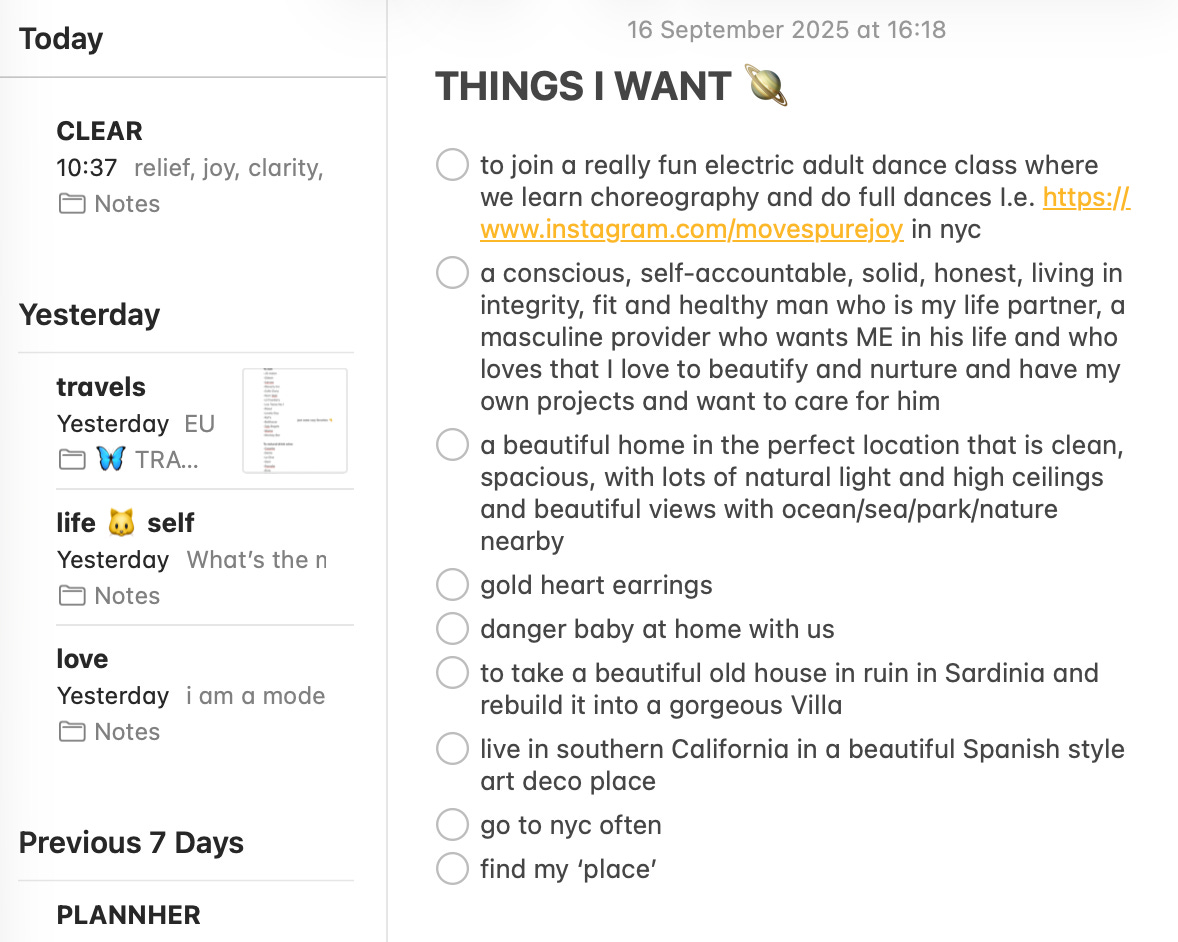
    Sometimes we lose touch with what we’re drawn to, what we want, desire, or even like. It happened to me recently. I couldn’t access the parts of myself that once pulsed with desire. Too much had happened too fast, and life spun me around until I didn’t quite know who I was anymore. So I began a small, secret practice I call ‘Things I WANT’ list. Since I no longer knew what I wanted, I started collecting clues. Every time I heard someone talk about something they were doing, experiencing, or feeling, and my body reacted with a quiet spark of recognition, a soft ‘me too’, I wrote it down. Because they revealed something about how I wanted to feel. Over time, those little notes became signposts back to myself. 

    some things I overheard ppl speak about that I noted down

    Desire is a compass. The things you want are indicators of what nourishes you, what enlivens you, what helps you remember who you are.


    nourishment

    Nourishment is the way you feed your mind, body, emotions, and spirit so that your life can function at full capacity, so that your presence can hold space for yourself and others. 

    Rest is nourishment. Play is nourishment. Silence, ritual, beauty, immersion in nature… they are infrastructure. 

    When you nourish yourself, you create a nervous system that feels safe to expand, a body and mind capable of holding joy, curiosity, and creativity without depletion. Everything you build: your work, your relationships, your life path, is only as sustainable as the inner ecology that supports it.

    Pay attention to what sustains your energy rather than depletes it. Notice which conversations leave you full and which leave you empty. Notice what thoughts and stories you tell yourself that feel like nourishment, and which ones tighten, constrict, or exhaust. Notice how movement, food, and environment affect your clarity, focus, and vitality. Nourishment is as much about subtraction as it is about addition. Removing what drains you, creating space for what feeds you. 

    The more devoted you are to this kind of inner prosperity, the more effortlessly your life flows, because you are operating from fullness rather than deficit.

    prosperity

    Prosperity is measured not just in money but in clarity, in capacity, in the freedom to create the life you want. It is the overflow of a well-tended inner world. A life in which your essence is honoured, your instincts are trusted, and your energy is devoted to what makes you feel alive. 

    The work is always inward first: nourishing yourself, holding space for your evolution, cultivating self-trust and intuition. 

    Then, and only then, does the external world respond, drawn to the light you carry. Your inner abundance becomes a magnet. Attracting resources, opportunities, and experiences that match the vibrational reality you have already created for yourself.

    Nourishment and prosperity are inseparable. One is the root; the other, the fruit. Without tending the root, the fruit cannot ripen fully. With devotion to yourself, your energy, and your essence, abundance flows as a natural consequence of a life lived in alignment.

    The heart of transforming your life is knowing yourself intimately. 

    Not superficially, but at the level of your thoughts, feelings, instincts, desires, and patterns. Change doesn’t begin with the outside world; it begins with you, with the way you show up in your own life. 

    The question isn’t just what you want, but who you are being as you move through each day, as you respond to challenges, as you make choices. Are you living out of your authentic soul essence, or are you unconsciously following old patterns, conditioning, and expectations that no longer serve you?

    Taking responsibility for this is understanding that every small choice either nourishes you or depletes you. When you begin to show up for yourself in alignment with your essence, you learn what truly sustains your energy, what makes you feel alive, what your life needs to flourish. 

    This is the work of self-knowledge: observing without judgment, naming the ways conditioning has shaped you, and making deliberate choices to nourish yourself in the ways that matter. Only when you are clear about who you are and what nourishes you can you begin to recognise what kind of life is right for you. 

    In our next step of this series, we begin to build that life externally. But first, let’s complete this section here:

    practice

    Take this week to quietly study yourself. Not your habits or productivity, but the subtler currents underneath: what lights you up, what drains you, what makes you feel most you.

    Each day, jot down one small observation about what nourishes you and one about what depletes you. Don’t try to fix or optimise anything. Just notice. This is how self-intimacy begins: through witnessing, not forcing.

    At the end of the week, look at what you’ve written. See if you can trace the shape of your essence through those notes. The qualities, environments, and rhythms that bring you alive. Those are the clues to the kind of life that fits you.

    micro-vow

    “I am willing to know myself deeply.
    I take responsibility for how I show up in my life.
    I will tend to what truly nourishes me,
    so the life meant for me can find me.”

    comment

    What’s one subtle way you’ve noticed yourself living out an old pattern that no longer fits? Share it below. Naming it is the first act of coming home to yourself.

    P.S. A peek into CLEAR (clear your path, change your life), landing in November.

  • trust yourself, trust your path

    4/8 — the fourth rule of her way club (aka: how to change your life in 6-12 months)

    SEP 28, 2025

    Continuing our 8 rules of her way club series. If you’re just joining, begin here:

    1/8 — deciding to play by your own rules
    2/8 — subtracting what doesn’t belong
    3/8 — the natural consequence: uncertainty
    interlude — her way deep rest
    4/8
     — trust yourself

    where I am writing this to you from, today

    The fourth rule of her way club is about owning your path.

    I’ve just returned from a kundalini yoga class. At the start, our teacher said: “There are two things people fear most in themselves: their anger and their instinct. But we need both: to metabolise anger and to connect with instinct. How could anyone not feel anger in these times, with the world stage pulling antics that belong to centuries past?”

    I thought about her words all class. Anger and instinct are scary because they’re truth tellers. And truth is confronting. It forces us to face ourselves or others in ways we’d rather avoid. It makes us choose paths outside the norm.

    The kriyas focused on metabolising anger. Hot, annoying, fast movements and breath that help me unglue myself from my subconscious resistances. I have my own private anger to metabolise. Anger is a fire: it burns away what isn’t meant for you and fuels you to do things differently. Anger gives you agency to choose your most authentic path.

    Instinct is different. Instinct is information. It tells you, moment by moment, what next step to take. And every time, you have a choice: trust yourself and your path, or not and pay the consequences until life offers you the chance to choose again.

    If rule one was claiming your agency, rule two subtracting what doesn’t belong, rule three embracing uncertainty and the deep rest required to hold yourself through it, then this, rule four, is about owning your path. We are at the heart of our journey.

    Most people follow the crowd, chasing safety, belonging, and love. They measure success on someone else’s scoreboard: celebrity culture, external validation, possessions that inflate the ego for minutes rather than decades. They mistake comfort for alignment. They choose paths where the ending is visible. But knowing how the story ends doesn’t mean it’s the right story for you.

    Comfort, in fact, can be the cage that keeps potential small and life mediocre. The more your life reflects your authentic code, the more alive you feel. The more you resist it by staying small, safe, palatable the more numb you become. At some point, you have to admit: the life you’ve been living might not actually be yours.

    There are three keys to owning your path:

    • Self-trust: developing your instinct and allowing yourself to make mistakes.
    • Enthusiasm: devoting yourself to what makes you feel alive.
    • Surrender: letting yourself not know exactly how it will play out, and trusting anyway.

    This is the ‘her way’ approach to creating a life that is actually yours.

    Key 1: Self-Trust

    Everything is spiritual, even the most ordinary logistics. Self-trust is where your inner world meets the outer one. It’s deeply practical. The more you trust yourself, the easier life feels.

    Without self-trust, you continue to outsource decisions, scanning others’ opinions, adapting to their expectations, and doubting your own instincts. This is exhausting. It makes you feel wobbly and unsafe.

    With self-trust, everything shifts:

    • You get things done. Procrastination fades when you trust yourself to follow through.
    • You feel steadier and safer. The world softens when you know you can rely on yourself.
    • You grow your instinct. Each decision becomes practice, and even mistakes turn into evidence that you can handle whatever comes.

    Self-trust begins with a choice: gathering your energy back from the outside world and returning it to yourself. Each time you stop looking outward for permission and instead ask, What feels true for me? you strengthen that muscle.

    It’s about being available to yourself. That means listening inward and actually honouring what you hear with action. It means tending to your body, energy, and emotions so you have the capacity to show up for your own needs. It means following through with integrity, doing what you said you’d do because you are in relationship with yourself.

    Self-trust doesn’t mean getting it right all the time. It means allowing yourself to act in the unknown, to risk imperfection, to treat mistakes as feedback instead of evidence against you. The more you do this, the more natural and effortless it becomes.

    When you trust yourself, you stop second-guessing, stop beating yourself up, and start freeing up energy for what matters most. Life flows differently. Relationships soften. And you begin to notice how the universe meets you halfway, aligning the pieces once you’ve chosen to stand firmly in your own inner ground.

    Key 2: Enthusiasm

    To live your way, you need enthusiasm. The word itself comes from the Greek enthousiasmos, “having god within.” It’s being lit up by a divine spark. Enthusiasm is devotion to what makes you feel most alive. It’s the master key to the good life.

    To practice enthusiasm, your task is simple, but not easy: notice. 

    Notice what distorts time, what makes focus effortless, what fills you with ideas you can’t put down. Enthusiasm leaves traces: goosebumps, a quickened pulse, the sudden sense that the world has tilted open in possibility. These are signals pointing you toward your path.

    Redirect your intensity away from chasing people or external validation, and toward the skills, projects, and fascinations that nourish you. Pour your energy where it multiplies, not where it leaks. Accept what cannot be changed. Eliminate or outsource what drains you.

    Then make it real. Literally block off one to two hours each day: a standing appointment with your own aliveness. Do the things that bring you excitement, that light you up. 

    For me, that’s starting the day, phone off, writing for two hours every morning. As I have shared before, writing informs every other part of my life that literally brings my dreams and visions to life. For you, it might be something else. Devote yourself to it.

    Enthusiasm is both compass and fuel. It shows you where to go and gives you the stamina to keep going, even when the path is uncertain. The more you cultivate it, the more your life begins to feel like your own: alive, expansive, divinely guided.

    Key 3: Surrender

    Surrender is the alchemy that allows everything else to work. It’s letting go of the need to control the outcome, releasing the illusion that you can map every step of your journey, and trusting anyway. It means holding your agency and your enthusiasm, while allowing the unknown to unfold.

    Surrender begins with a choice: to step into the unknown without fear of being “wrong.” Life rarely delivers guarantees, and the map you imagined often fades the moment you try to follow it. Surrender is the practice of leaning into uncertainty with calm, of showing up fully even when the next step is invisible.

    It’s also a recognition that the universe, or life, or your own deeper self, is smarter than your anxious mind. When you act with integrity, follow your instinct, and devote yourself to what makes you alive, surrender allows the pieces to align in ways you cannot predict. You trust that the guidance you feel, the enthusiasm you cultivate, and the self-trust you’ve built are enough.

    Surrender is giving over. Giving over to the flow, the timing, the magic that only emerges when you stop resisting. It’s a practice: showing up for your life without needing to know the whole story, trusting that the steps you take, even imperfectly, are carrying you forward.

    When you surrender, you move with grace instead of struggle. You release the tension of trying to force outcomes, and you open yourself to the full richness of living her way.

    I have so many stories from this year alone about practising self-trust, enthusiasm, and surrender, stories I’d love to share. But for this her way club series (aka: how to change your life in 6–12 months), I want to stay focused on giving you the tools to take steps in your own way. I trust your innate intelligence to guide you. If you’d like more of my personal stories woven in, let me know.

    practice: the self-trust check-in

    Take five minutes to check in with yourself and your inner guidance. Write down:

    • One decision you’ve been hesitating on, and what your instinct is telling you.
    • One area where you’ve been looking outside yourself for approval.
    • One small action you can take this week that aligns with your own guidance, not someone else’s.
    • One way you can honour your energy, emotions, or body to show up fully for yourself.
    • One past moment where trusting yourself paid off, and how it felt.

    Notice the difference between what your mind overthinks and what your deeper sense knows. This is your internal compass — your self-trust — sharpening.

    micro-vow

    This week, pick one moment where you’ll act from your own guidance, not what anyone else says you “should” do. Say it aloud:

    I trust myself. I trust my path. 

    comment prompt

    What’s one small act you can take this week to follow your own instincts, rather than someone else’s rules? Share it below…

  • her way deep rest

    SEP 21, 2025

    tldr; I created a *free* 10-day journey for you to reset your relationship with rest. enjoy!

    her way deep rest

    After a tragic start to summer, on my birthday, I made a promise to myself for August:

    To take the entire month off from: solving my life problems; making any significant decisions; doing anything simply because I think I should; or setting any future goals at all, other than giving myself the gift of not doing any of that.

    Emotionally exhausted after all the chaos, I knew I needed to slow down and listen deeply. To choose rest not as a last resort, but as a truly integrated practice. But it was haaaarrrrddddd!! And, I realised, I didn’t know how?!

    I didn’t feel tired, exactly, but I did feel like I could never fully exhale. Like some part of me was always switched on. Tracking. Tensing. Ready for the next thing. I knew how to “rest” in all the ways we’re taught: I took breaks, I stretched, I meditated, I journaled, I lit candles, took long walks and soaked in the bath. And they were all helpful, to a degree. But still, there was something in me that didn’t know how to feel rested. Not fully. Not deep in my bones.

    Rest, it turned out, wasn’t something I could figure out or do my way into. I had to meet it in a different way. What I discovered is this: for many of us, especially those of us who have built our lives around being reliable, strong, sensitive, capable… rest is not familiar. Not in the way we crave it. And not in the way we need it. 

    her way deep rest

    For the past month, I have been taking you on a journey called the 8 rules of her way club, a series (aka: how to change your life in 6-12 months). If you’re just joining, begin here:

    1/8 — deciding to play by your own rules
    2/8 — subtracting what doesn’t belong
    3/8 — the natural consequence: uncertainty

    This series is a rite of passage, a journey of transformation, with each rule a threshold: decide → subtract → disorient → differentiate → root → express → design → create. 

    Parts 1–3 (above) shape the self-concept (inner stance). 
    Parts 4–6 coming next map the ecosystem (inner/outer harmonics). 
    Parts 7–8 move into agency. We braid outwards from inner truth to outer action. 

    By the end of these 8 rules, you won’t be the same person you were when you started. They offer you a simple and gentle framework to begin choosing your way.

    After the most recent rule or step: uncertainty, many of you replied with some version of: “But how do I stay there? How do I not rush to fill the space?”

    And my best answer is this: you learn to rest. To rest in uncertainty, in the unknown. To lean, gently and softly, into the void and the magic dark. Not just take breaks, not just “self-care,” but rest in a way that lets the body exhale all the way down.

    This summer taught me that deep rest is a kind of surrender, a skill we have to practice if it has been forgotten. For me, that has looked like letting myself slow to the point where I could actually feel what was happening inside me. Letting myself soften enough that the tears, or the joy, or the hunger, or the pleasure could come through. Then, when the body feels resourced, gently introduce a bit of aliveness again.

    I had to learn to rest deeply and fully: to rest when I am resting. Matched by strategically putting myself in active stress states where the challenge slightly exceeds my skill level, that turns into flow, creating a sense of inspired action: to do when I am doing.

    Learning how to do this was not as obvious as I thought it would be. I want to share the process I took myself on with you, now.

    her way deep rest

    Our nervous systems have learned to associate safety with being “on.” And so when we try to slow down and try to rest, we don’t feel better. We often feel agitated. Anxious. Bored. Or quietly ashamed that it doesn’t feel good the way it’s supposed to.

    Rewiring our nervous systems so that we can experience deep rest is one of the hardest things we can do in the current world we live in. And one of the most important. It doesn’t happen overnight. You don’t wake up one day as a brand new person. These changes happen by showing up with dedication, even when our minds persuade us to turn back.

    Recently, I shared that:

    I refuse to sacrifice my health, social life, or time to build a business like most entrepreneurs do. Most people think those things are a natural part of starting a business, but they are not if you don’t choose them to be. 

    A big piece of that is that I am incredibly intentional with how I design my days. I have written before, and often, that my choices stem from knowing what I don’t want, the above, for example, which informs what I do want, which is:

    To be of service without overgiving or burning out. And to show others how this is possible.

    That means I practice what I preach, putting my needs for both: activation and challenge, as well as rest and peace, at the forefront of how I design my days. While this is a moving target, it generally means that I start my day with meditation and leave my phone turned off for the first 2-4 hours of the day, while I write/feel/think/dream/dflow. I am meeting my need for time and space, which is necessary for me to be of service.

    While I aim to start my days with slow mornings, sometimes my nervous system kicks in and says, “you have to get straight to work” (I don’t, not really). Or “you have to check your phone to see if there’s anything urgent you may need to see “ (there never is). 

    There’s this survival instinct inside of me that feels that if I don’t get started on my work immediately, my entire business/life/world will fall apart. Because this is precisely what I’m trying to rewire, I breathe into it, force myself to put away my phone, and sit down to write. Often, I sit there and it’s really uncomfortable. But this discomfort is exactly what rewires my old operating system.

    When I slow down, I create more time. With more time comes more space. Practising deep rest is the best way I know how to slow down and rewire my nervous system to create the two things I value the most: space and time.

    Deep rest is not really glamorous or sexy. It’s essential training for learning to hold discomfort without collapsing or distracting. To be with oneself and notice what is really going on underneath the superficial currents, feel the feelings, think the thoughts, to hold them for a moment, and then to let them pass. The more we can hold, the more we teach our bodies to rest deeply.

    This audio-visual ‘her way’ deep rest reset was born from that space. 

    The tender space between knowing you need rest and not knowing how to reach it. I created her way deep rest first for myself. Then, for my private clients. And now for you.

    For you, who has done the work, who is self-aware, who understands the theory, but whose body is still waiting to feel what her mind already knows. For you who doesn’t necessarily feel tired, but is wired. Who lives with a hum of subtle vigilance just below the surface. Who doesn’t want another thing to do…

    This is a quiet invitation to meet your body where it is. To stop performing “rest” and begin to experience it as something safe, nourishing, and real. Let’s go there together.

    her way deep rest

  • the first rule of ‘her way club’

    1/8

    The first rule of her way club is simple… 

    You have to decide if you are in or if you are out.

    Because until you make that choice, everything else in your life will be decided inside someone else’s frame.

    Every life is shaped by decisions, small and large. And there is one decision that sits above them all, one that becomes the axis of everything else: the choice to refuse the life you were handed at birth, without your conscious consent. You cannot create a life of your own until you first spit out the one you inherited.

    Yet, I know, I do know… saying no without knowing what you are saying yes to can feel more terrifying than leaping into thin air. Bear with me here…

    Most of us are taught to believe that the path is already paved. Follow the milestones. Take the job. Choose that kind of partner. Buy the house. Keep your head down. Belong by blending in. Stay safe by avoiding risk at all costs. 

    But the truth is, no one can hand you your way. They can only hand you theirs. To choose yourself, you must reject the average, the conventional, the status quo. You must be willing to step outside of the structure, even when your knees are shaking, and build your own frame of meaning.

    I want you to think of your life like a frame through which you see and choose. Most people live inside a frame they did not build. It tells them what to want, what to work for, what to measure themselves against. And then one day, something cracks. 

    The desire for freedom stirs. The realisation dawns: this frame is wrong for me.

    Here’s the paradox: freedom is not the absence of barriers. It is not drifting without edges or guardrails. Left unchecked, that kind of freedom quickly becomes its opposite: chaos, distraction, exhaustion. You don’t want freedom without form. What you truly want is the freedom to shape the form yourself. You want choice.

    That is why people are drawn so quickly to external structures: human design, astrology, sacred systems, even self-help frameworks. They promise clarity, rules, a map. But as soon as they become limitations, they are no longer helpful. We are here to do whatever we want, to follow whatever expression of Self is closest to the nexus of our soul.

    When these systems become limitations (see: projectors saying they can’t take action unless they have been tangibly “invited”), we must decondition ourselves from the programming that has us operating from “shoulds.” That’s why you need to create your own system, structure, framework, or code of existence. An inner guiding light.

    You do not want goals handed down by parents, teachers, bosses, society or culture. You do not want to inherit someone else’s scoreboard. And yet, in mistaking all structure for confinement, you risk throwing away the very thing that can save you: a system of your own making. Structure is not the enemy. Borrowed structure is.

    The ones who flourish are not the ones who float freely. They are the ones who build a world they want to live inside. They create rules that make sense for them, principles that become a compass when life threatens to scatter their attention.

    That’s what her way club is about. 
    Now… are you in, or are you out?

    Most people will give you a destination. Some will give you the steps to reach it. But almost no one will hand you the most vital thing: the navigation system to set your own coordinates and chart the path.

    Her way club is a way to unearth the rules that make sense for you. Over the next two months, I will send you weekly rearrangements of perception, direction, and focus. Each one is meant to become a small hinge that, over time, swings open an entirely new door.

    Integrate them into your mind, your choices, your actions. Give yourself 6-12 months. And then look back at the life you’ve quietly built.

    I remember the first time the words “not this” rose up inside me like a prayer and a rebellion all at once. I must have been nineteen, maybe twenty. I was living in London, filling in as a temp admin for a world-famous bridal magazine while I searched for a career path or life direction that felt like me. In a room too bright, clinical, fluorescent lights buzzing above a room full of people. People who looked bored, resigned, living a life that was supposed to be glamorous but really was pushing papers around to meet the deadlines and fill the ad pages. Their shoulders rounded, already defeated by life.

    I stood there, pretending to be immersed in my work, printing page after page at the printing machine for someone else to read through and sign, my body buzzing with a strange, quiet panic.

    In that moment, I felt it in my bones: not this.

    Not this life of ticking boxes and following rules that don’t belong to me. Not this slow suffocation dressed up as success. I remember staring at the clock, the second hand dragging itself forward, and thinking if I stay here, if I follow this way, something in me will wither before it even has a chance to bloom.

    That was the first crack. The first place I realised that the path laid out in front of me was never going to be my own.

    For me, it was less of a clear epiphany and more of a visceral aversion. A slow gathering of no’s. I looked around and saw lives that felt like cages: bodies grown stiff with lack of movement and sunshine, minds dulled by routine, relationships that had calcified into resentment and silence, jobs that took more than they gave. 

    Something in me whispered, with startling sharpness: Not me. Not this. Nope.

    I will not have a partner I resent.
    I will love in freedom and respect.

    I will not hate my body.
    I will live at home in my skin.

    I will not live to please a system that is broken.
    I will build a life that pleases my soul.

    I will not silence my voice.
    I will speak the truth that burns inside me.

    I will not abandon myself.
    I will choose myself, again and again.

    That whisper was the first hint of my anti-vision. If I could not yet say what my life would look like, I could at least say what I refused and wanted, instead. And that was enough to begin.

    This is where your way begins too… with the clarity of rejection. 

    When you truly reject the outcome of being like everyone else, you begin to gather fuel. Every time you encounter something that makes you contract, something you know you cannot live with, you are being handed a data point. Write it down. Take it on a walk. Let it carve an outline of the life you will not accept.


    This is the first half of the frame: the shape of what you are walking away from. But then comes the harder work: choosing what to walk toward.

    I didn’t know exactly where I was going, but I began to set my aim, in the form of living principles. I wanted to build a body that could carry me well. I wanted a mind that grew stronger every time it was tested. I wanted work that felt like service, not servitude. I wanted to live in devotion to excellence, the soft and steady commitment to becoming myself more fully.

    Your version will look different. It must. 

    This is not about copying a blueprint. It is about cultivating your own. Every woman has her own constellation of desires, but the throughline is the same: to grow in body, in mind, in spirit, and in the work you contribute to the world.

    Still, here is the truth that stops most people: 

    The fear of the unknown is heavier than the fear of becoming like everyone else. 

    And so you stay in place. But there comes a moment when the grief of sameness, the dread of mediocrity, the ache of a life unlived, becomes more unbearable than the fear of stepping into uncertainty. That is the moment of decision. 

    That is when you know you are in.

    Over the next eight weeks, this ‘rules of her way club’ series will serve as a navigation system. Not a map to someone else’s life, but a framework to help you chart your own. Together, we will learn how to treat uncertainty as signal, how to live a life so unique it becomes spiritual practice, how to root into your inner essence and your prosperity, how to shape an outer life of belonging and contribution, how to claim the mantle of creator, and how to design a life that is unmistakably yours.

    But all of that begins here. With one decision. With one yes, or one no.

    a practice for you, to begin:

    Take ten minutes today to begin your anti-vision. On a blank page, write down everything you know you do not want. Allow this to be your sharp truth. What type of existence would kill your spirit? What kind of love would shrink you? What routines would flatten your days? Take that list for a walk. Let your body feel the weight of it, and notice how the air tastes different when you silently promise yourself: 
    Not me. Not this.

    a micro-vow:

    “I commit to the excellence of being fully myself. From now on, I choose my way.

    a note from the field:

    I often work with women who have built their lives according to rules they thought they had to follow. From the outside, they look accomplished. Inside, they are hollow, uninspired, disconnected, and alone. Worse than lonely… cut off from themselves, from desire, from the messy, vital core of living.

    And so the questions rise, sharp and relentless:

    Why start a business if it only multiplies your stress?
    Why birth a child if it means years of fractured sleep?
    Why create, when that same time could be spent doing something useful?
    Why fall in love, when the ending might split your heart clean in half?

    Because that is the point of being alive.

    This — messy, uncertain, beautiful — is what life is. And when a woman finally admits, often through tears, that she hates the trajectory she was on, the story that felt already written with a predictable ending… something shifts. 

    That acknowledgement is not despair, it’s the crack in the frame. The fracture where light gets in. The first signal of her way. Your way.

    Every new life begins there.

    comment below:

    Tell me one thing you refuse to accept for your life. What belongs on your anti-vision list?

  • rebuilding

    I make my life transparent in these letters to you. Often with more ease than one would expect, but not always. I write candidly about the way I try to meet the gaps in my care as a child, I reveal aspects of my lifestyle that are often unmoored, I hapazardly and ambitiously run several online streams of value-for-income models, and I wear my heart on my sleeve when it comes to my romances. 

    I have been moving through some of the tenderest times of my life recently. There are moments when I feel like life is so empty and devoid of meaning and substance. There are moments when I feel like life is exploding with colour and joy. These moments are opposite, and yet they coexist. Both are true.

    And it is times like these that bring me closer to something that we all sense:

    Comfort is seductive, but it’s not where we grow. We grow on the edge of things. 

    As I wrote in my stories yesterday. You have two choices:

    a) Continue forcing the version of you that will keep your current life stitched together at the seams.

    b) Surrender to the logic-defying, painful, beautiful, soul-awakening mess of where life wants to take you.

    Both are true. Sometimes you will need to hold on. Sometimes you need to let go. Devotion and commitment show up as different things at different times. 

    For me, the answer now is surrender. And that surrender requires a rebuilding. Not of my outer world, but of my inner scaffolding. A structure made not of strategies or timelines, but of gentleness, truth, and presence. The quiet integrity of choosing to meet each moment as it is, instead of trying to bend it into something I can manage or explain. The devotion of no longer abandoning myself, even when it would be easier to. Especially then.

    I begin with sleep. With rest that is heavy and uninterrupted. With giving my body the time it needs to catch up with everything my heart has carried these past months. Sleep has become sacred. A space where I remember I am not a machine built to function, but a being designed to feel.

    I pay attention to what nourishes me through the textures of ordinary care. I eat slowly. I walk often. I stay close to silence. I let my feelings rise without trying to trap them in language too soon. I cry when I need to. I let joy rise when it wants to, and do not hold it hostage with questions about whether it will stay. I am learning that being with myself in this way is not indulgent.

    I am tuning into my natural rhythm and letting that be enough. We all contain this natural intelligence.

    The only reason you ever feel out of step with your life is that you have stopped following the natural rhythm that your body and inner essence are always trying to lead you with. 

    We have become so accustomed to having the rhythm set for us by external forces. Parents. School bells. Job descriptions. Capitalism. Performance. Survival. We have spent our lives learning to respond to something outside of ourselves, and in the process, we forgot how to listen inward.

    We have handed over our agency in so many invisible ways that we no longer realise we are allowed to curate a rhythm of life that makes sense for us. A rhythm that honours our energy, our season, our humanity. We have accepted a pace that constantly makes us feel torn and separate and fractured, not because something is wrong with us, but because something is deeply wrong with the way we are being taught to live.

    I created Planet Powered to help you remember. 

    Not to replace your inner agency, but rather as a gentle framework to be used as a stepping stone. A structure that holds you within the shape of your modern life while still making space for a sovereign choice, each and every day, to ask what you truly need, and how you want to meet the world from that place.

    This rhythm is not about productivity or performance. It is about presence. It is about remembering that you are not here to fit yourself into a life that was not made for you. You are here to create a rhythm that holds your soul.

    We begin in two days.

    join us here, now 𓁹 𓁹

  • you are planet powered 🪐

    …as I discovered one day when I went for a walk with my astrologist Zoe on London’s Hampstead Heath

    I didn’t set out to live in rhythm with the planets.

    I was just trying to figure out how to get through the week without falling back into the old paradigm of life and work.

    It was a decade ago, sometime in the early years of my business, that tender in-between season when you’re no longer in the old world (but still haunted by its rules), and not yet anchored in the new one. I had refused traditional work because I craved freedom. Flexibility. Something that felt like mine. But what I found was that freedom — without structure and rhythm — can feel like floating in deep water without anything to hold onto.

    Each day bled into the next. I was either wildly inspired or totally untethered. I’d start Mondays trying to be productive, then spiral into guilt when I couldn’t focus. Some days I’d push myself to work until 10 pm. Other days, I’d drift, half-present, getting nothing done and feeling even worse about it.

    It wasn’t that I didn’t love the work. I did. But I was still trying to move through time as if it were a flat surface. Like each day should hold the same energy, the same productivity, the same focus.

    And then something shifted.

    One day, I went for a walk with my astrologist Zoe on London’s Hampstead Heath. We were examining wild-grown herbs and trees, discussing how they relate to each individual. At some point, the conversation drifted to how we organise our days and how fortunate we were to go for a walk in nature on a beautiful day while everyone else was stuck behind a desk in a square room somewhere. She mentioned in passing a simple idea: that each day of the week is ruled by a planet. Each one carries its own essence. A mood. A direction. A rhythm.

    Fascinated, I took myself to the British Library and fell into a deep research dive on anything I could find out about the days of the week being related to planetary systems. As it turns out, in a vast number of languages, the names given to the seven days of the week are derived from the names of the classical planets in Hellenistic Astronomy, which were in turn named after contemporary deities, a system introduced by the Sumerians and later adopted by the Babylonians from whom the Roman Empire adopted the system.

    Monday is ruled by the Moon. Of course it is. Monday blues are real! That’s why it always felt so emotionally dense. Tuesday, by Mars — no wonder I always wanted to push through my to-do list that day. Wednesday — Mercury — my best meeting day. And so on…

    It’s not new information. It is ancient, and that felt like remembering something I already knew in my bones. So I started experimenting.

    Just gently at first. I stopped scheduling intense work-heavy starts to the week on Mondays. I started batching bold, courageous tasks on Tuesdays. I held my meetings on Wednesdays and saved my writing for Thursdays. I let Friday be soft. Sensual. More space, less noise.

    The changes were subtle, but the impact was immediate. Suddenly, I wasn’t pushing against myself anymore. I had a relationship with time: one that felt intimate, reverent, and alive.

    I started feeling less like I was managing time, and more like I was dancing with it. Listening. Responding. Moving in flow. The more I lived this way, the more everything began to shift.

    My business felt more coherent. My body relaxed in response.

    I could actually feel the difference between a Moon day and a Mercury day. I have language for my inner world and permission to meet each day with integrity and grace.

    Introducing:

    PLANET POWERED ~ https://stan.store/herwayclub

    A new rhythm for life — soft, structured, and alive.

    Inside, you’ll find:

    • 114-page guide
    • Six tailored lifestyle guides
    • Energetic themes for each day of the week
    • Planetary symbolism and modern integration
    • Custom: calendars, cheat sheets, and daily rituals
    • Journaling prompts, reflection tools & real examples
    • live Telegram community for connection and support: July 13–August 10

    $55 — INSTANT ACCESS


    What if your whole week made sense?

    What if you knew exactly why Monday always feels a little heavier… And why Tuesdays feel sharper, more focused… And why by Friday you want to wear something cute and take yourself out dancing (or at least light a nice candle)?

    There’s a reason. You don’t flail or feel your way through the week by accident.

    There are real, rhythmic forces influencing your emotions, energy, and attention — every single day. But we’ve been trained to ignore that rhythm.
    To push through. Force clarity. Work like we’re machines.

    Planet Powered invites you to live differently.

    To stop fighting time — and start flowing with it.

    Planet Powered is a new way to move through time — ancient, intuitive, and wildly effective.

    ✦ Why this matters

    ✔ You stop wasting energy on the wrong things at the wrong time
    ✔ You feel more emotionally supported and less scattered
    ✔ You create with more ease, confidence, and momentum
    ✔ You find a rhythm that’s both soulful and sustainable
    ✔ You stop asking “what’s wrong with me?” and start asking “what’s the energy today?”

    This guide will teach you how.

    Time isn’t flat. It’s textured. Alive. Rhythmic.

    ✦ Who this is for

    • You’re self-employed and want a rhythm that balances structure with flow
    • You’re in a corporate job but craving more soul and spaciousness
    • You’re a parent trying to stay grounded inside the chaos
    • You’re a student or seeker looking to live more intuitively
    • You’re done with pushing. You’re ready to align

    Whether you’re an entrepreneur, seeker, parent, student, or simply someone craving a new way to relate to time, this guide offers structure without rigidity, softness without chaos, and a return to something your body already knows. 


    Planet Powered includes tailored guidance for different life paths.

    Each day of the week carries a unique planetary frequency.
    It has since ancient times — and deep down, your body already feels it.

    • Monday is ruled by the Moon — emotional, internal, tender.
    • Tuesday belongs to Mars — bold, active, focused.
    • Wednesday is Mercury’s — clear, communicative, connected.
    • Thursday expands under Jupiter — wise, generous, abundant.
    • Friday glows with Venus — beauty, love, creativity.
    • Saturday grounds us in Saturn — structure, integrity, completion.
    • Sunday re-centres in the Sun — joy, self, radiance.

    When you honour that rhythm instead of override it — everything changes.

    You stop pushing against your own energy. You stop trying to be everything, every day. You stop feeling like you’re constantly behind.


    Instead, you begin to flow…

    This is what Planet Powered is here to help you do:
    Reorient your life around the energy that already lives in the week.
    Through a steady rhythm.

    $55 — INSTANT ACCESS


    Why I created this

    When I first left behind traditional work, I was craving freedom. But freedom without rhythm just left me overwhelmed. I didn’t want the rigid 9-to-5. But I didn’t want to drift endlessly, either. I needed something that felt both fluid and practical. A system that could hold me, without boxing me in. That’s when I stumbled across the planetary week… and everything clicked.

    Suddenly, I understood why certain days flowed and others didn’t. I stopped forcing deep work on Moon days. I started writing on Mercury days, launching on Jupiter days, and resting on purpose. This rhythm didn’t make me productive. It made me present.

    That’s what I want for you.

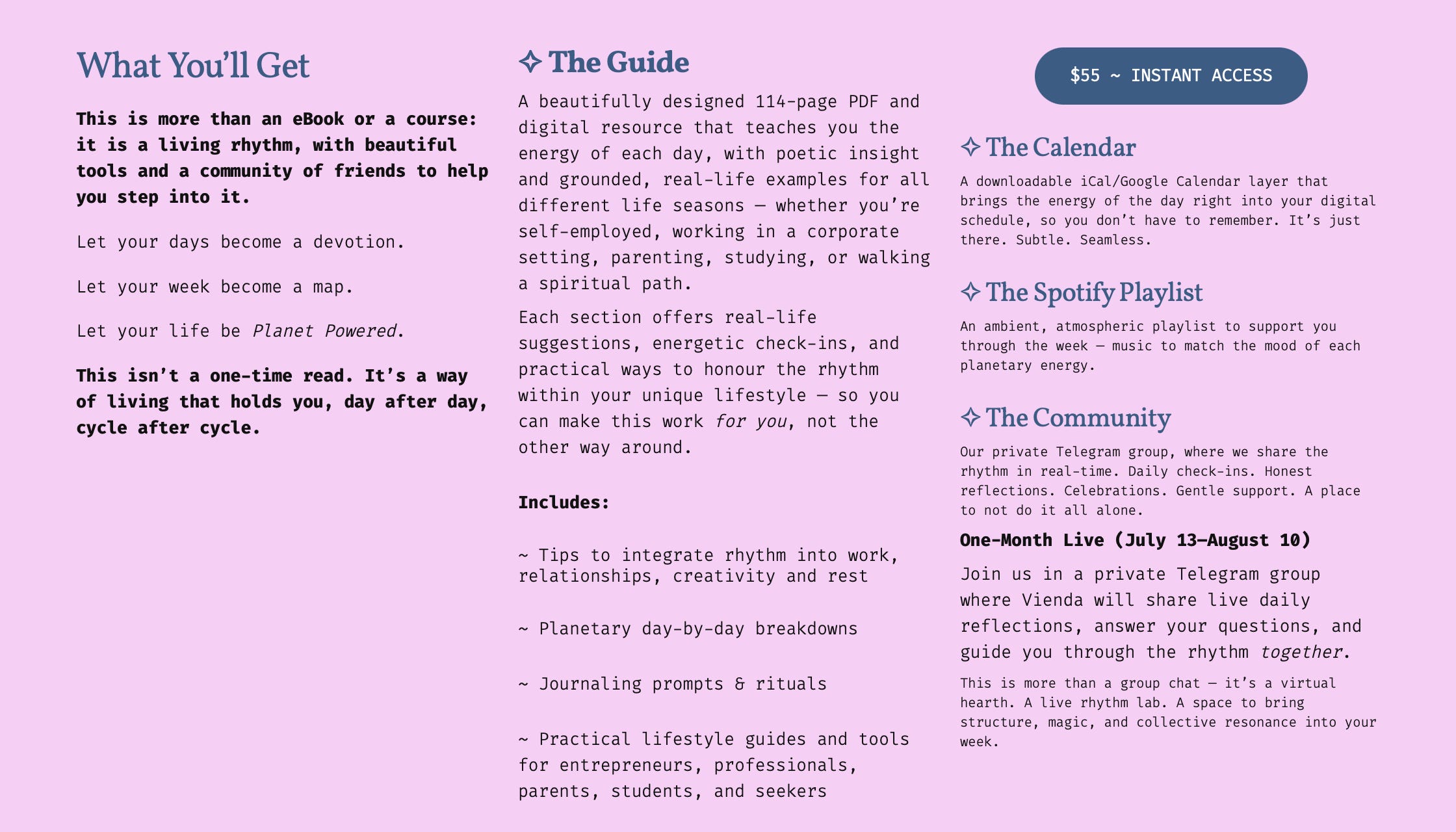
    What You’ll Get

    This is more than an eBook or a course: it is a living rhythm, with beautiful tools and a community of friends to help you step into it.

    Let your days become a devotion.

    Let your week become a map.

    Let your life be Planet Powered.

    This isn’t a one-time read. It’s a way of living that holds you, day after day, cycle after cycle.

    ✧ The Guide

    A beautifully designed 114-page PDF and digital resource that teaches you the energy of each day, with poetic insight and grounded, real-life examples for all different life seasons — whether you’re self-employed, working in a corporate setting, parenting, studying, or walking a spiritual path.

    Each section offers real-life suggestions, energetic check-ins, and practical ways to honour the rhythm within your unique lifestyle — so you can make this work for you, not the other way around.

    Includes:

    ~ Tips to integrate rhythm into work, relationships, creativity and rest

    ~ Planetary day-by-day breakdowns

    ~ Journaling prompts & rituals

    ~ Practical lifestyle guides and tools for entrepreneurs, professionals, parents, students, and seekers

    $55 — INSTANT ACCESS

    ✧ The Calendar

    A downloadable iCal/Google Calendar layer that brings the energy of the day right into your digital schedule, so you don’t have to remember. It’s just there. Subtle. Seamless.

    ✧ The Spotify Playlist

    An ambient, atmospheric playlist to support you through the week — music to match the mood of each planetary energy.

    ✧ The Community

    Our private Telegram group, where we share the rhythm in real-time. Daily check-ins. Honest reflections. Celebrations. Gentle support. A place to not do it all alone.

    One-Month Live (July 13–August 10)

    Join us in a private Telegram group where Vienda will share live daily reflections, answer your questions, and guide you through the rhythm together.

    This is more than a group chat — it’s a virtual hearth. A live rhythm lab. A space to bring structure, magic, and collective resonance into your week.

    $55 — INSTANT ACCESS

  • practices that help me reclaim my self-trust

    one decision at a time

    “When I came in this evening, I was so identified with my emotion,” I said, twisting to face the teacher. “I was like: I’m so saaaaad! WWWAAAAHHHH!!!” I exaggerated, earning a few giggles from behind me.

    It was a rainy night in NYC’s Lower East Side. I was at a yoga and philosophy class.

    Speaking in front of others used to terrify me. I’d flush with heat, my thoughts would tangle, and my voice would betray me. I’d prepare what I wanted to say in advance, rehearsing endlessly in my head while others spoke. By the time it was my turn, I wasn’t even there anymore. I was so consumed by trying to say the ‘right thing’ that what came out was a jumbled mess. Then came the shame spiral. I hated the awkwardness of being seen.

    I used to think I was shy.

    But really, I didn’t trust myself.

    As I continued sharing, I said, “But then I moved and sweated and got into my body, and loosened the grip sadness had on me. I remembered that I am not my feelings, I’m just a person having feelings. And now, I feel fine! So I guess… yoga works!”

    We all laughed. That’s why we’re here. Because it works.

    It struck me again how easy it is to forget what we know when our minds are loud and cluttered. When we can’t hear the part of us that already knows

    That’s the ache of self-abandonment.

    When, at the end of the day or week, or season, you realise you’ve lived from doubt instead of trust. You ignored your intuition. You bypassed your knowing. You outsourced your truth. And now you feel like a stranger to yourself.

    That is not a feeling I enjoy. 

    You don’t trust yourself because you’ve never been taught how. Because you’re afraid of making mistakes. Because the noise of the world is so loud that your inner voice doesn’t get heard.

    Self-trust doesn’t just happen. 

    It’s not the result of being perfect or always making the right choice. 

    It’s a relationship. 

    One that begins when you decide to start showing up for yourself with consistency, clarity, and care. A big part of that is creating enough mental space to actually hearyourself.

    One of the most practical ways I anchor into my own self-trust is by gently clearing out the mental and energetic clutter. When my mind is quiet, my intuition becomes louder. My clarity returns. I know what to do next because I can feel it again.

    Here are some of the practices that help me return to that place:

    Let yourself take a proper social media break. Even one full day away can shift your entire nervous system. Delete the apps. Reclaim your attention. Eat breakfast without scrolling. Go for a walk without your phone. Remember what it feels like to live in your body, not just online. You’re not going to miss anything. Everything important will still be here when you return.

    Stop checking email first thing in the morning. Give yourself at least one sacred hour before you open your brain to the demands of the world. That slow morning is magic and deserves to be protected. Use it to write, stretch, dream, create, listen. You can reply to emails later, when your creativity doesn’t need your full bandwidth.

    Turn off all unnecessary notifications. Not every ping deserves your attention. Not every alert is urgent. Let your phone serve you, not the other way around. (The only notifications allowed on my phone are phone calls and messages.)

    Make a list of the decisions that are swirling in your mind. Take note of the unmade choices weighing you down, and decide on them. All at once, if you can. Yes or no. Now or later. Decide to decide, or decide not to decide until next month or next year. Give your brain the closure it craves.

    Close open loops. Send the email. Pay the invoice. Return the item. Follow up with the person. You will be astonished by how much mental energy you free up when you stop dragging yesterday’s loose ends into today.

    Declutter your phone. Most of us have dozens of apps we never use. Delete what doesn’t support the version of you that you’re becoming.

    Delegate what you can. For so long, I resisted delegation. But delegation is actually about accepting and receiving help. It’s wise. It creates more time, space, and energy for the things only you can do. And it gives others a chance to support you, which they often want to do.

    Make amends where needed. Apologise. Forgive. Repair. Set things down that you’ve been carrying around in silence. Even if it’s something small, clearing the emotional debris makes room for a deeper self-trust to take root.

    When you do all this, even a few of these things, you begin to soften into yourself. You feel more grounded, more lucid, more resourced. You don’t need to grasp or hustle for answers because you can access them right here, within yourself.

    This is the work of The Way She Knows.

  • you might fall in love on an ordinary Thursday and move to New York six months later

    you might fall in love on an ordinary Thursday and move to New York six months later

    …an honest letter about starting over in the world’s most famous city

    After a month in New York, I’ve concluded that it really is like living inside a movie. Yesterday, walking through the West Village, we passed one of the leads from YOU and that comedian my boyfriend calls “the ‘I’m a swan!’ guy.” I wouldn’t have recognised either of them, but he’s a pop culture encyclopedia, which I find endlessly entertaining.

    The most charming thing about this city is how hard it tries not to be American. It’s clinging tight to its immigrant roots, claiming the most obscure and beautiful bits of the many cultures that built it.

    In the vlog above, you’ll get a glimpse of my first chaotic, cosy, overstimulating, sunshine-filled weeks in the city, from yoga class revelations and focaccia-making to lazy girl makeup rituals and navigating PMS in a place that never stops buzzing. I reflect on how long it takes to feel grounded somewhere new, what I love about NYC (surprise: the water??), and the tiny wins that help me find my pace in the madness. 

    I came here with the intention to document it all. To share the magic of experiencing everything for the first time. But the truth is, while I love it here, I don’t have as much space or time as I once did. I used to languish in my creativity — let it ooze out of me like molten lava. Now, I live in a studio apartment on the Lower East Side with my boyfriend (who also works from home), and the luxury of spaciousness just… isn’t available right now.

    Which means two things: one, I need to carve out more time and space that’s mine, and two, I need to learn how to create within the chaos. To let inspiration move through me, even in the chaos and noise.

    Something is changing in me. I’m becoming someone I don’t quite recognise yet.

    Usually, I’m a step ahead of life. I can see what’s coming. But right now? Life is a step ahead of me. I’m being asked to trust. Not because everything is certain, but because I can.

    People often ask how I’ve built such deep self-trust. The answer isn’t about what I’ve done differently. It’s about what I’ve let go of.

    My self-trust lives in the space I’ve cleared for it.

    In my early twenties, when I was stumbling through my first spiritual awakening, I discovered — quite accidentally — a clearing process I now call the RRRRI Method:
    Reflect · Review · Release · Replace · Integrate.

    I’ve taught this to hundreds of clients.

    It came to me one night, maybe 15 years ago, while I was lying in bed meditating. I was new to it then, but it gave me a peace I hadn’t known before. A quietness that made space for things to rise up. The kind of space that lets truth speak.

    I carried around a lot of pain.

    My mum struggled with depression and anxiety, and as a sensitive kid, I absorbed much of it, believing it was mine. My dad died when I was ten. My stepdad, who entered the picture when I was four, was cruel, verbally and emotionally abusive. At one point, when I was six, he made me live in a caravan outside while the rest of the family was in the house. My mother joined him in the abuse. She told me later she thought siding with him would make it easier on me. 

    That’s the surface-level story, and honestly, it’s not the point. I share this not for pity, but to offer context — to show you the shape of the beliefs I had to unravel in myself.

    Maybe you’ll recognise some of them:

    I am not wanted.
    I am not lovable.
    I am not safe.
    I have to do it all alone.
    I can’t ask for what I need.
    It’s not safe to speak up.
    I must not upset others.
    There’s something wrong with me.
    I have to hide who I really am.

    That night, in meditation, I felt frustrated. I kept circling back to these painful memories. It felt like I couldn’t move forward. And suddenly, a thought came:

    These memories aren’t hurting me. I’m hurting me — by replaying them.

    They were still active in me because they were unresolved.

    I realised that every emotional block, every limiting belief, is just an unprocessed experience we’ve held onto for safety. At one point, those beliefs helped us survive. But they outlive their usefulness. And instead of releasing them, we keep them close out of habit — or fear — and they start to manifest in our lives, in our bodies. As pain. As illness. As stuckness. As stories we can’t seem to rewrite.

    That night, I didn’t get caught in the stories. I just let the feelings rise. Memory after memory. Sadness, anger, grief — I let it all come, and I felt it. Fully. Until it softened. I cried for hours. I forgave myself. For how I had carried it all for so long.

    And something in me shifted.

    Over the days and weeks that followed, I kept practising. Feeling. Releasing. Replacing. Integrating. And little by little, things began to change. I lost the extra weight I was carrying. My skin cleared. My eyes were brighter. My relationship to food, to my body, to myself softened. I began to like who I was. To see my own beauty, not just my flaws. Life itself looked and felt different.

    And now? I teach that same method inside The Way She Knows

    Because when you begin to clear out the old noise — the stories, beliefs, and inherited patterns that were never truly yours — you don’t just feel lighter. You feel free. Free to trust yourself. Free to choose what’s true for you. Free to follow your feelings without needing to explain, justify, or prove a thing.

    From that place, life starts to unfold in the most unexpected, beautiful ways. You stop gripping for control, and instead start co-creating with the world around you. You stop chasing clarity, and somehow, it finds you.

    You might fall in love on an ordinary Thursday and move to New York six months later. (That’s what happened to me :). You might find yourself changing careers, shifting relationships, saying yes to things you once feared, and letting go of things you thought you needed — not because something’s wrong, but because something inside you has become deeply right.

    When you trust yourself, you don’t need to have everything figured out. You just need to listen. You need to stay close to that quiet knowing within. And when you do, the next step always reveals itself.

    That’s the way she knows. And it’s already inside you.

    Come join us.

    We begin on Monday, May 26th, enrolment closes Friday, May 24th.

  • choice architecture + invisible currents

    because so much of what we do each day isn’t really a choice, not in the conscious sense

    A month ago I was invited to teach this workshop for The Wild Ones CommunityToday I decided I would share it with you too.

    The premise is that we are moved by invisible currents. Nudged by our surroundings. Directed by systems we didn’t design.

    Through this workshop, we’re going to pause and pay attention.

    To notice the subtle structures shaping our decisions — from the arrangement of a room, to the rhythms of our inbox, to the silent expectations in our relationships.
    And then… gently, deliberately, begin to redesign them.


    practical exercise (if you feel called to it)

    Choose one area of your life where you feel stuck, or where you tend to make choices you later wish you hadn’t.

    Then:

    1. For three days, notice and document all the environmental cues influencing your behaviour in that area — the physical setup, digital distractions, people nearby, time of day, even your energy levels or mood.
    2. Identify the three strongest “currents” — the forces most powerfully pulling you off course.
    3. Share your most surprising or interesting discovery in the comments below. What did you notice, now that you are really looking?

    You never know — your insight might help someone else spot a current they didn’t even know they were swimming in.


    this is where we go deeper

    One of the quiet teachings of The Way She Knows is that your inner knowing isn’t something you have to find but rather something you return to, again and again.

    And to return, we need to notice what pulls us away.

    We need to see the systems, structures, and subtle influences that guide our days and ask: Who designed this? Is this serving me? What do I want instead?

    This is an act of reclamation. 

    It’s a way of lifting the veil on the environments and patterns that keep you in loops and gently beginning to reorient them toward the life you actually want to live.

    It’s less about control and more about tending. Less about discipline, and more about designing your life to support the way you want to feel.

    That’s the deeper current of this work: To live in a way that’s attuned, not just to your values, but to your body, your seasons, your intuition, your truth.

    This is how she knows.
    Not by force, but by design.

    Maybe today something was brought into focus — a pattern, a pull, a way you’ve been shaped — The Way She Knows is where we go deeper.

    Together, we release the limiting beliefs, patterns, and conditioning that keep you stuck — and rebuild trust in your own voice. Guided by the RRRRI Method (Reflect · Review · Release · Replace · Integrate), you’ll receive daily audio teachings, soul-led prompts, and two live group calls to support you in returning to your truth and leading your life from within.

    You’re invited. If your body says yes, come join us. We begin in 14 days.

    JOIN HERE

  • let life be really good

    some thoughts on softness

    Some years are made for fighting shadows, some years are made for dreaming dreams, some years are made for wholly living, some years are made for falling in love, some years are made for heartbreak, and some years are the dark, rich spaces in-between that tie all the other years together.

    There are moments in every woman’s life 𓂃 often subtle, always significant 𓂃 when she realises she’s been waiting for life to feel good later.

    I am that woman, too.

    After the move.
    After she’s earned it.
    After the next launch.
    After she’s healed enough, achieved enough, grown enough.

    It’s not that she doesn’t want goodness now.
    It’s that her nervous system doesn’t recognise it as safe.
    She’s built her identity on high-functioning self-reliance, on holding it all together, on always preparing for the next hit of chaos.

    Goodness feels foreign. Untrustworthy. Fleeting.

    But there comes a point when you get tired.
    Not just tired in your bones, but soul-tired.
    Tired of bracing for bad news.
    Tired of living on emotional adrenaline.
    Tired of feeling like peace is something you can only visit in short bursts.

    This moment is an invitation: what if life gets to be good now?

    your body doesn’t lie

    If your system is used to surviving, “good” can feel unsafe.

    Calm can feel like a threat.
    Pleasure can trigger shame.
    Stillness can summon panic.

    We don’t override that reality by shaming it. We honour it. We meet ourselves there.
    Letting life be good begins with learning how to stay with good. To recognise it. Receive it. Regulate in the presence of it.

    This isn’t just a mindset shift. It’s a somatic one.

    Which is why I ask myself:

    What are the tiny signals of goodness I can practice noticing?
    ✧ the softness of my sheets in the morning
    ✧ the kindness in a stranger’s eyes
    ✧ the miracle of a moment with nothing to prove

    The more I notice, the more I can hold.
    The more I hold, the more I trust.
    The more I trust, the safer it feels to expand into joy without sabotage.

    you don’t have to earn softness

    So many of us were raised on invisible contracts that said:

    Be good, then you’ll get love.
    Work hard, then you’ll get rest.
    Suffer well, then you’ll get your reward.

    It creates a rhythm of deprivation, where we become addicted to proving our worth through pain. It keeps us stuck in cycles of over-functioning, over-giving, over-efforting.

    But what if we broke the contract?

    What if softness wasn’t a prize at the end of your endurance?
    What if it was the starting point?

    This is the paradox of receiving: you can’t force it.

    You have to soften enough to allow it. That softness — that capacity to receive life fully — is a practice of presence, not perfection.

    It asks:
    Can I let myself enjoy this moment without earning it?
    Can I stop bracing for it to be taken away?
    Can I let it be this good, this easy, this free?

    practicing your way into goodness

    Letting life be good isn’t about bypassing the hard stuff.
    It’s about refusing to let pain be your only portal to meaning.

    Here are some ways I’m practicing:

    1. Noticing where struggle has become identity.
    Do I feel more real when I’m suffering?
    More valid when I’m busy?
    More lovable when I’m useful?

    2. Replacing performance with presence.
    Instead of performing wellness, I’m allowing mess.
    Instead of performing peace, I’m regulating in real time.
    Instead of performing power, I’m rooting into truth.

    3. Setting up small rituals that remind me I’m safe to enjoy.
    A slow morning. A spontaneous dance break. A walk without my phone.
    Tiny practices that say to my system: this is safe, this is safe, this is safe.

    4. Choosing environments that don’t require me to shrink.
    The people, spaces, and structures I choose are part of the goodness.
    They reflect back the truth that I don’t have to abandon myself to belong.

    a closing truth

    There’s a quiet rebellion in letting life be good.
    In refusing to rehearse old wounds.

    In choosing to orient toward pleasure, peace, and enoughness, not as a reward, but as a right.

    And like all rebellions, it takes practice.

    But the more we choose it, the more it becomes familiar.
    The more we hold it, the more it grows.
    And the more it grows, the more we remember: this is what we were always meant for.

    Let your life be good, not someday, but now.

    Not because you’ve earned it.
    But because you’ve remembered how to receive it.

    This is the work we do inside ‘The Way She Knows.

    A gentle, practical journey to release the limiting beliefs, patterns, and conditioning that keep you stuck and to help you reconnect to your quiet knowing.

    We start on Monday, May 26.

    Earlybird price ends on Monday with the full moon.

    The Way She Knows

  • clovers

    clovers

    about clovers, consciousness, and coming home to yourself

    The first time I searched for clovers, I was lying in the garden of my grandparents’ home, cheek pressed to the grass. I must’ve been three or four. My mother, crouched beside me, coaxed me to listen. “You can hear it grow,” she said. She weaved her hand through a patch taller than the rest, her voice low and conspiratorial. “We’re looking for a four-leaf clover,” she told me. “One in every ten thousand is lucky.”

    I was spellbound. Even at that age, I think I knew somewhere inside my tiny chest that this was what I’d always be doing. Looking for signs of the mystical, the invisible, the more-than-meets-the-eye hidden in plain sight.

    Years pass. Another country. Another version of me.

    It’s 4 a.m. in Bristol, and something wakes me. A vibration. Somewhere in the distance, a sound system is thrumming through the earth like a call. I dress quickly, wrap an oversized scarf around my shoulders, fill a water bottle, and step out into the still-blue dark.

    The streets are half-asleep, but I’m pulled forward. Down narrow lanes. Through a tunnel tagged with messages like prayers. I follow the sound, lose it briefly to the growl of a generator, then find it again. Cresting a hill, I arrive to see a hundred people scattered across a grassy knoll. A makeshift DJ booth. Giant speakers booming techno into the sky.

    Someone walks up to me immediately, parched. He gestures toward my bottle. “Of course,” I say, handing it over. When he finishes drinking, he presses a little white pill into my palm. A thank you.

    I take it without thinking, settle down into the grass beside someone I half-know. My fingers begin to idly stroke the blades. And then, suddenly, I see one. A clover. Four leaves. Then another. Then another. Seven in total, all nestled in a single patch beneath me like a private miracle.

    I fold six of them into my notebook and give one to my neighbour, giddy. I’m high. The music is inside me. The sun is coming up and everything feels full, like the veil between the seen and unseen has grown thin. My heart is pounding with joy.

    Reality, I’ve learned, is never neutral. It bends through the lens of the mind that’s perceiving it. What you see, what I see, it’s never the same thing. We’re all wandering around inside our own maps, shaped by family, culture, memory. When we insist that ours is the only truth, we miss each other entirely.

    Fast forward again. Tuscany, Italy. A villa hidden among olive trees. I’m here with a lover, invited to help with the harvest. For days, we rake olives from branches and into nets, the work sweet and repetitive, the kind that exhausts the body just enough to quiet the mind.

    On the fifth morning, I froth milk over the stove and carry two coffees outside. The children from the house circle around me, their chatter light and skittish as birds. One of them, a two-year-old girl, calls me “Honey.” She can’t pronounce Vienda.

    I feel the now-familiar pull. My eyes land on a darker patch of grass. I set the coffee down and kneel.

    “What are you doing, Honey?” she asks.

    “I’m looking for a four-leaf clover,” I reply.

    And there it is. Right in front of me. Then another. The adults gasp. I hand both to my lover. He presses them into the back of his journal like evidence.

    There’s magic everywhere if you know how to see. But so many of us have forgotten. We’ve been taught to expect danger, to defer to logic, to stay in line. We’ve been told that surrender is foolish, softness is weakness, and intuition is unreliable. And so, we trade our knowing for safety. Our voice for approval. Our inner wisdom for the illusion of control.

    But eventually, the body remembers what the mind has tried to override.

    Just days ago, here in New York, the city was swelling with that first hot breath of spring. We had plans to board a ferry across the Hudson but missed it. The next wouldn’t arrive for hours. So we walked back towards home.

    We’d both been cooped up working, he on a book that’ll be published later this year, me on a course called The Way She Knows, which had just opened for earlybird enrolments. We need sunlight. Air. Movement.

    As we meander along the river, I stop. “Wait,” I said, “I want to check something.”

    I crouch beside a small patch of green growing along the sidewalk. Something had tugged at me, quiet but insistent. I peer closer and blink. The biggest four-leaf clover I’ve ever seen. Massive. Radiant. Impossible. I show him.

    “What the heck!” he says. “It’s like you knew it was there.”

    I smile, gleeful and press it gently between two bills in my wallet. Because of course it was there. Of course I knew.

    There comes a point in every woman’s life when she realises:

    It’s not the world holding her back. Not the people around her, or the circumstances, or the past. It’s the quiet, looping stories she inherited. The beliefs. The patterns. The protections.

    I know this terrain intimately.

    For years, I lived split in two, pulled between what I felt and what I’d been taught to believe.

    Until I couldn’t anymore.

    Reclaiming myself wasn’t a single moment. It was a thousand tiny ones. Clearing those internal blocks, not just intellectually, but somatically, emotionally, spiritually, changed everything. It gave me back my voice. My clarity. My intuition. My joy.

    That’s what this two-week journey is for.

    A reclamation.
    A remembering.
    A return to the way you know.

    𓂃 𓈒𓏸

    The Way She Knows
    A two-week course to reconnect you with your inner wisdom

    Enrolment opened: Monday, May 5
    Earlybird ends: Monday, May 12 (with the Full Moon 🌝)
    Enrolment closes: Friday, May 24

  • this life is a dream within a dream ☁️

    about NYC being a place of contrast requiring inner stability, and the quiet strength of being well-resourced

    When I stepped out of JFK airport and followed the signs to the subway, I braced myself. New York is known for its edge, its abrasion. I am soft. I tend and protect that softness like a flame cupped in two hands. I wasn’t sure how it would survive here.

    I tapped my phone at the turnstile and joined a tall young man in the elevator. He wore headphones and held himself like someone accustomed to noise. Still, I turned to him, map pulled up on my phone, unsure where to go. He removed one earbud, glanced at the screen, and said in the gentlest voice, “You can’t get the F from here, but if you take the K, you can transfer in three stops.” 

    I blinked. He had such a kind presence. His softness mirrored mine. Maybe there’s space for gentleness here, after all.

    I followed his directions toward the Lower East Side. A few minutes into the ride, the unmistakable smell of urine filled the carriage. A man down the carriage—middle-aged, Chinese descent—had wet himself and begun swearing loudly. Slurring. Angry. A different kind of edge.

    This city, I’m learning, holds everything. Softness and despair. Precision and chaos. A young man with headphones offering quiet directions. An older man unravelling in public. Here, opposites coexist, unapologetically. New York is a city of contrasts, and that is, perhaps, its defining trait.

    The days have spilled into one another like rainwater pooling in uneven stone. Time behaves differently here. Moments stretch. Then vanish. Weeks slip past before I can grab hold. What I’m learning is this: I cannot tether myself to the outside world. It’s too volatile. Too fast. Too much.

    Instead, I tether myself inward. I return to a still point inside me — a quiet place I cultivate through ritual and self-devotion. I nurture it like a small garden: feeding it with breath, rest, laughter, water, movement, music. A daily act of remembrance. Of protection. Of belonging to myself.

    Sometimes, it’s as simple as walking to Whole Foods alone, sending a few voice notes to the women who hold me in their hearts. That ten-minute walk fulfils two needs: solitude and connection. It’s imperfect. But it’s enough.

    Work is another tether. Returning to it each day — whether I want to or not — grounds me. I write. I build. I teach. I remember who I am. Even when the city pulls me in every direction.

    Last night, friends made homemade pizza and poured glasses of white wine. We ate slowly, talked about art, about cities we’ve loved. And then, walking home, we passed a man with his trousers around his knees, bare bottom exposed, head buried in a trash bin. Of course. That’s New York, too.

    Right now, I’m writing this during a live co-writing session for The Art of Noticing. Eight of us are here, silent on Zoom, warm orchestral music in the background. Earlier, we spoke about a line from one of my recent essays about being a well-resourced woman. We explored how writing can teach without instructing. That sometimes, the lesson is simply in the living.

    In Her Way Club, this here community I lead, that’s what I teach: how to listen inward. How to find your way—not the right way, not the perfect way, but yourway. In writing. In loving. In parenting. In creating. In becoming.

    And to find your way, you must first be resourced. You need space. You need softness. You need access to yourself.

    Being resourced is a privilege, yes. But it’s also a practice. A skill we build and rebuild. I see it as the art of tending to our inner ecosystem. Of becoming our own safe haven.

    It means expanding your capacity to meet life without collapsing. Learning to sit with discomfort. Making choices from groundedness, not panic. It doesn’t mean you never need others. It means you’re not uprooted every time the wind blows.

    How do you become that person?

    You start small:

    • You build a daily rhythm that supports your nervous system.
    • You learn to breathe when you want to scream.
    • You create a home that feels like a hug.
    • You save a little money, even when it’s hard.
    • You learn to cook a meal you love.
    • You reach out and you know how to be alone.
    • You keep learning. Keep listening.

    This is what I’ve brought with me to New York. Not just clothes and books and dreams, but tools. Practices. A soft heart and a solid core.

    And maybe that’s enough to belong here.

  • what I did yesterday

    The task is simple and deceptively difficult: What did you do yesterday?

    We have always been curious about the lives of others.

    Long before television and tabloids, we craned our necks at windows, imagined stories behind closed doors. That impulse to know, to glimpse, to understand is ancient. We are, all of us, secret witnesses, seeking reflection, seeking difference, seeking the tender knowledge that we are not alone.

    “Ah,” we think, “so this is how another human moves through the day. How strange. How ordinary. How marvellous.”

    Most of us, if asked, would call our days unremarkable. We would point to the routines, the errands, the silences, and shrug. But presence alters the lens. What once seemed plain is suddenly flooded with texture:

    The amber glow of morning through the blinds.
    The brief pleasure of a spoon against the roof of the mouth.
    The idle reaching for a book, for a thought, for another hand.

    A life, it turns out, is made not of milestones, but of minutiae.

    It was this quiet revelation that shaped this week’s assignment in The Art of Noticing, the six-week writing club I am leading. The prompt is borrowed, with gratitude, from Aisling Marron of Notes From New York, who herself was inspired by a podcast of the same name.

    The task is simple and deceptively difficult: What did you do yesterday?

    No digressions. No rewinding or fast-forwarding. Only the bare, shining truth of a single day, as it unfolded.

    Here is mine:

    7:00am
    My boyfriend’s alarm goes off, the buzz slicing through the heavy fog of my sleep. I roll onto my side, eyes gritty, my head thick and stuffed with cotton wool. Regret clings to me immediately. Regret for the ambitious plans I agreed to, for not protecting the softness of this morning. But I am an adult and adults honour their commitments, so I climb down the ladder from our loft bed, bare feet pressing onto the cool wooden floor. I pull my aligners from my mouth, soak them in their cleaning agent, put the kettle on, and drop an ‘immune support’ Yogi tea bag into favourite mug. I find my tiny jar of Egyptian Magic and bring it and the tea to the sofa. My face aches, pulsing with the imprint of too-little sleep and the too-salty dinner from the night before. I settle into the cushions and begin to massage my lymph nodes slowly — chest, neck, jawline, cheeks, scalp — coaxing the fluid back into its pathways, feeling the swelling subside little by little. These small, tender rituals make me grateful for everything I’ve learned about how to tend to myself.

    7:30am
    My boyfriend finds me curled up on the sofa, kisses me. “How did you sleep?” he asks, and I reply “Fine”. I stretch my arms overhead and yawn, “The problem with making plans ahead of time is you never know how you’re going to feel when they arrive.” I splash warm water on my face, wipe off the leftover balm with a soft cloth, and brush my teeth, waking myself up bit by bit. He laughs and mixes creatine into two glasses of water — one for each of us. We sit shoulder-to-shoulder as I quickly scroll through my social apps, answering urgent messages and uploading the next The Art of Noticing lesson for my writing club. “Let’s go for coffee!” he suggests, and I peel myself away to dig through drawers in our little walk-in wardrobe, finding black leggings, a soft, sky-blue yoga tank, and my favourite Free People fleece that still smells of Portugal.

    8:15am
    As we descend the narrow staircase of our building, he tells me in hushed tones about how he heard someone fiddling with our lock in the night. A chill prickles up my spine; New York feels wild and unpredictable. We agree to tell the landlord, unsure how concerned we ought to be. Our favourite coffee shop is tucked just under our building, but he’s craving a vegan croissant, so we detour to Essex Market, the morning still crisp and pale. When we arrive, the market is shuttered, the gates still pulled down. Even New York, it seems, has its limits. By the time we return, the coffee shop has filled with people; there’s a queue spooled inside. We squeeze in, order two coffees and a few treats: a tahini cookie and oat cappuccino for him, a flat white and buttery croissant for me. I’m still hollow from yesterday’s hunger and bite into the pastry peeking out of the paper bag before the coffees arrive.

    9:00am
    I log onto Zoom for a meeting with an alumna from The Mentor Training. As we speak, my sluggish mind lifts into a higher orbit, buoyed by the energy of possibility. I remember — oh yes — I have built things, beautiful things. I have made worlds out of ideas. It’s so easy for me to forget, to always chase the next horizon without pausing to admire the view. Having it mirrored back to me reignites a quiet fire inside.

    9:45am
    We end the call with a plan and a few fresh objectives, and I scramble around our tiny LES apartment gathering keys and my phone, throwing back a glass of water before running to yoga class. I arrive breathless but just in time. The teacher welcomes me warmly: she’s tall, with a fluid grace, long stretchy limbs, and a soft accent that feels instantly soothing. She gestures for me to grab two blocks and a strap, and I find a space right at the front. A man plops down beside me at the last moment. Round-bellied, bald, but adorned in a pink ballerina-style outfit, bright red lipstick and nails to match. I smile to myself: we’re all girls here today.

    10:00am
    We begin on our backs, breath deepening, bodies sinking into the earth. The teacher’s style is light and casual, her voice weaving through the room like a ribbon. As we move into slow sun salutations, I feel the two decades of practice unfurling in my muscles, a familiar dance. Movement practices like yoga are an anchor for me, a home I can return to no matter how much the outer world shape-shifts. By the end of class, every inch of me feels stretched and rinsed clean. I thank the teacher quietly, wipe my mat with a lemon-scented towelette, and slide my Birkenstocks back on, feeling the earth a little closer beneath my feet.

    11:30am
    A 10-minute voice note from my bestie is waiting, so I pop my headphones in as I wander home, the city buzzing around me. I duck into a small beauty boutique and marvel at the rows of glass bottles and creams before finding my beloved Italian leave-in conditioner. $42, I am willing to invest in. As I browse, I send her a stream-of-consciousness voice reply, not to inform but to process; our sacred girlfriend ritual. It’s therapy in miniature, given and received without expectation.

    11:45am
    By the time I get home, I’m ravenous. I find my boyfriend deep in work at the tiny kitchen table and ask if he wants to share a picnic. He nods silently as I pull guacamole, purple corn chips, and baby carrots from the fridge. I slice tofu, arrange everything on a big plate, and pour coconut water into tall glasses. We carry it all to the coffee table and sit cross-legged, eating with our fingers and laughing about nothing in particular. I love how easy nourishment can be when it’s shared.

    12:30pm
    The shower is in the kitchen, a relic from the building’s pre-plumbing past. The hot water washes the morning away: tea-tree scented soap, a razor across my legs, a shampoo bar in my hair and afterwards my new leave-in conditioner combed through and coconut oil slathered on my skin with slow devotion. Fridays are for beauty, for romance, for the small Venusian acts of pleasure. I leave my hair to air dry, slip into shorts and a loose lounge top, and tidy the apartment, vacuum humming underfoot. I can’t sit down to work until my space feels clean and peaceful.

    1:00pm
    I curl into child’s pose on the sofa to write emails, tucked into myself. Eventually, my legs go numb, and I unfold with a sigh. I tick through admin tasks for The Mentor Training, refilling my water glass now and then. Around 3pm, I hand my boyfriend a glass too, scolding him lightly for not drinking enough. We giggle about something small and silly, and suddenly, at the same time, blurt out, “I love you.” He pulls me onto his lap, wrapping his arms around me tightly. “I love this,” he says, forehead against mine. “Working quietly together. Laughing. It’s precious.” I press my palm to his heart, and we both turn to admire the little pot of spring flowers blooming vibrantly in the window, as if blessing the day.

    4:40pm
    He has plans to meet a friend at 5:00pm, and I decide to tag along, craving fresh air more than another minute of screen time. I waste most of my twenty-minute warning scrolling, then throw on a dress and sneakers, and wipe a lip tint on, and we’re out the door. We meet his friend at Essex Market and order drinks — matcha latte for me, iced decaf for them — and wander through the golden slant of late afternoon. I find myself distracted by the light bouncing off the buildings, the life vibrating in the streets. We wander through hidden galleries, a park filled with wildly competitive ping pong matches, and a tiny poodle who decides to befriend me. On a tucked-away corner, I discover Casetta, the sweetest wine bar, and instantly decide we must return for date night.

    Casetta

    6:00pm
    We stop at a market to pick up a baguette, some hummus, pico de gallo, and tiny, perfect avocados. Bread in NYC is standard stale (why?) but we take our bounty home for a second, casual picnic at the coffee table, layering pesto and arugula and salt on thick slices. We eat quickly, laughing and stealing bites from each other’s plates, knowing we have to leave soon for our night at the Whitney.

    7:50pm
    The Whitney is alive, packed with people, more than we expected. It’s a little overwhelming trying to see the art through the thick crowd. Still, some moments shine. I overhear a girl say to her boyfriend, “You have marathons, I have stairs,” as we climb to the rooftop, and I laugh in solidarity. And at the top the whole city stretched out in luminous twilight. He pulls me close, kisses me with a rare, wild tenderness, and I feel something invisible and important shift between us.

    8:45pm
    We meander back downtown through SoHo and into LES, the streets thick with nightlife now, music spilling out of bars and windows flung open. New York shape-shifts after dark, but I don’t feel the pull to join it. I feel full already — full of the day, of the hours stacked like soft, golden bricks inside me.

    9:30pm
    We tumble onto the sofa and watch the latest episode of Severance, my body warm and heavy with tiredness. Afterwards, I move through my nighttime rituals: wash my face, brush my teeth, click my aligners back in. We climb the ladder into our loft bed. He wraps himself around me protectively, and I sink into his warmth, into the safety of our tiny kingdom, asleep almost before my head touches the pillow.

    Was it a good day? (They always ask that on the pod.)

    Yes — it was an excellent day. A day stitched with small joys: pastries and coffee, sunshine on skin, a body stretched long and sweet in yoga, easy laughter shared across a tiny kitchen table, a museum kissed by sunset, the heavy, sore satisfaction of a life well-lived inside an ordinary Friday.