the death of an 8-year-long lesson
JUN 23, 2026
This week I was planning to write about how the goal is not a life without friction, that life has edges, that we get to choose which ones we’re happy to run up against — raising children, braving the elements of the natural world, etc — after climbing the tallest mountain in Bali, an active volcano, last weekend. Which was so hard, particularly when an unprecedented1 wind appeared, threatening to tear our tiny human bodies off the summit and fling us unceremoniously into the sky.
I started writing it at the start of last week when all the details were still fresh in my mind: the smell of wildflowers on the path, the golden light of the afternoon sun dappling the leaves as we hiked up above the clouds, the satisfying ache of my thighs from the steep climb, the tears that sprang from my eyes when I thought I was going to die. I’m still going to write about it because I think it’s an interesting idea and something we all grapple with, consciously or not. But today I want to write about something else.
I’m on a visa run2: Bali, Singapore, Bali. The man at check-in warns me there’s a 50% chance they won’t let me into either Singapore nor Bali because they don’t like it when people do it in a 12-hour round trip, but I’ve taken the risk because my neighbour said it would be fine and I trust her. Plus, I got my lucky seat number: 8A, which I’m taking as a good omen. (My birthday is 8/8, plus it’s my numerology number, so 8 really is my number.)
The flight attendants with their perfectly manicured bobs and straight Asian hair are pushing a trolley, a wheel squeaking down the aisle, handing out tiny bottles of water and meals on trays to those who ordered them. Not me. I’m a strictly fasting-when-flying type, though I’ve found choosing the fruitarian option on long-haul works well too, because you just get a fruit platter, which aids digestion perfectly for when you land.
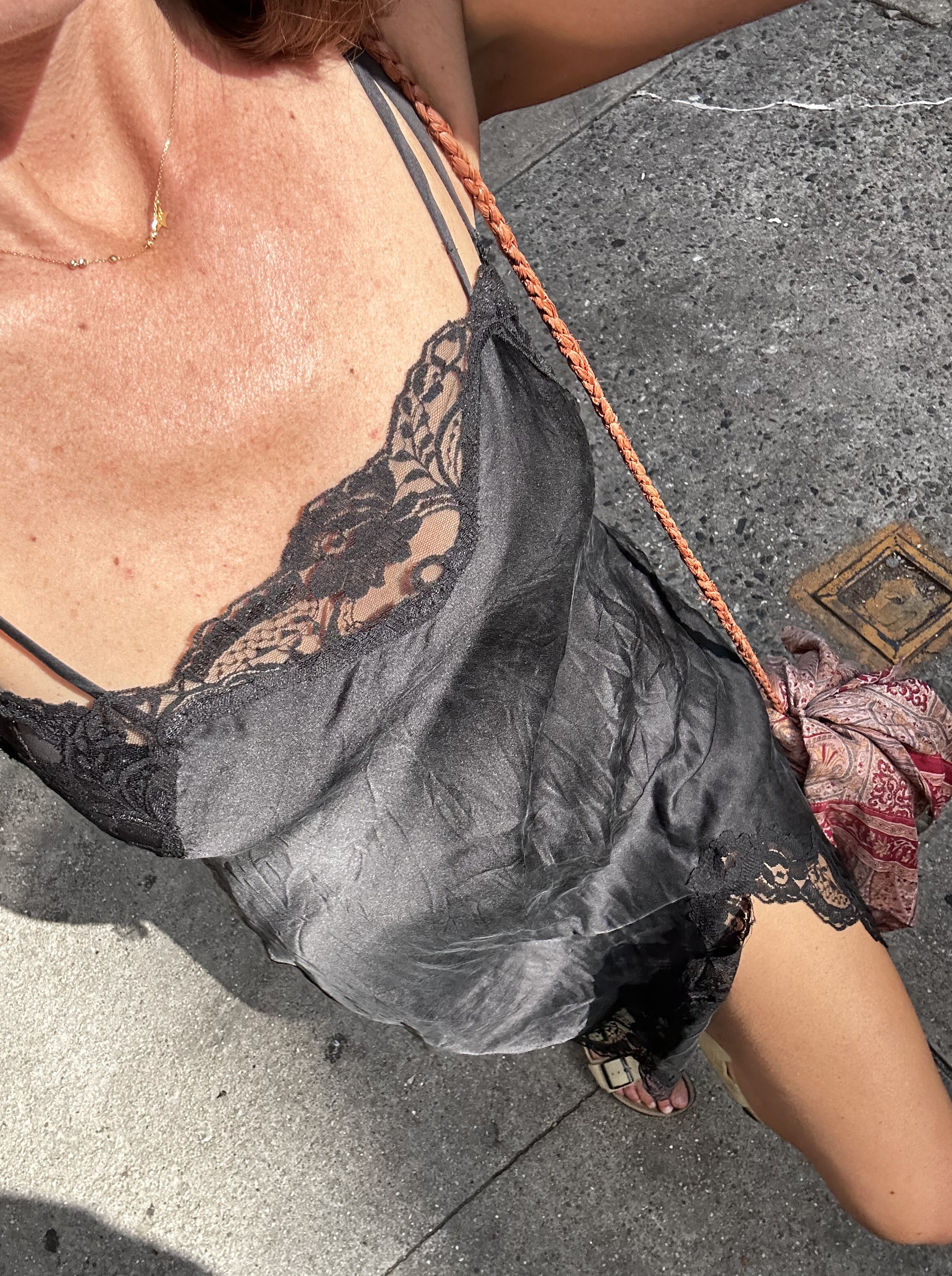
I’m wearing a long backless organic cotton Christy Dawn summer dress procured from Poshmark when I lived in NYC last summer, no bra, my comfiest tencel Uniqlo panties with a cherry on them, an Italian soft brown cashmere knit sweater bought on Vinted when I was in Paris, and dark brown soft suede loafers found at a Parisian market for €20. An outfit assembled for the full array of today: a motorbike ride to the airport before 7 am, an international flight that is inevitably too cold, and six hours in an airport. Then the same again in reverse. I hope to be showered and in bed by 11 pm.
Over the past three or four days, a new sweetness has blown into my day-to-day. This sweetness is difficult to describe because it’s so ordinary. The absence of a hardness running underneath my life, a subtle bracing against the world. A vigilance. Some part of me has always been scanning the horizon for the next disappointment, the next upheaval, the next thing that would require me to gather my strength and begin again. I am desperately clinging to this sweetness, hoping it won’t dissolve into nothingness.
That’s what I want to write about. The end of a truly harsh 8-year cycle. The death of an 8-year-long lesson. I read Leah Vanderveldt and Otherworldy on the astonishing astrology right now, and it spoke to me so deeply that I wanted to reflect on my own experience with it.
For the past eight years I’ve been circling a wound: where is my home, where do I belong, who are my people, where can I safely root and with whom? It has been all about relationships, self-worth, and security. Testing and exploring the right to simply exist and be sustained. Searching for possible answers from a million different vantage points, gathering experiences and evidence that might point me forward to the truth.
It was 2018 when this started, which feels like a lifetime ago. I don’t even recognise the woman I was then.
8 years ago I made the decision to remain estranged from my mother, after a lifetime of repetition compulsion: the unconscious drive to stay inside a painful dynamic, hoping each next time it resolves differently.
8 years ago I ended my tendency towards perpetual monogamy, drifting from one relationship to the next with barely a breath between them. I had been proposed to three times by then, but it was clear to me that it was not in my best interest to get married to any of those people. While some of them were genuinely great, we weren’t a fit. Since then, there were some situations that I got out of that were extractive, and I am grateful those chapters are over and for the lessons. People say we date our opposite-gender parent. I don’t think that’s quite right. We date the parent with whom we have the most unfinished business.
8 years ago, I moved into a house and lived on my own for the first time in my life and tried to learn how to stop outsourcing my needs for safety and security to others and instead learn the delicate way of trusting myself to become sovereign in my ability to care for myself.
8 years ago I started to grow from the confrontation of the parts of myself that had not matured or taken responsibility for my life.
2018 was the year I finally chose myself and my path in a way that I didn’t know was possible until then. But with it came the harsh realities of seeing the world in the stark, bright light of adulthood, no longer softened by adolescent ignorance.
I spent those 8 years reparenting myself, mothering and fathering myself, filling the gaps of care I hadn’t received in childhood, all whilst being entirely afloat.
I studied psychology for this reason and have spent years becoming fluent in family dynamics, reparenting, corrective experiences, the slow archaeology of inherited patterns. I have done all of this work on myself first. It is also, not coincidentally, one of the central reasons my clients seek me out.
In the last year I saw the last of my old familial patterns dissolve. Relationships I had been faithfully resourcing for years, smoothing over difficult moments, absorbing tension before it became conflict, from which I withdrew my energy, gently, without drama. Other relationships that genuinely sustain me grew stronger, as though they had been waiting for the space.
A short break for self-promotion: If you would like to learn how to use your writing as a functional brand-building tool, join me for Going Pro this July. Learn more here.
So far so good.
I have landed in Singapore, through immigration, ate the most delicious dumpling soup, sat in a Starbucks for a few hours editing the above while sipping soya milk tea, checked back in, passed through immigration again, and am now waiting to board my flight home. May all the angels and gods be with me upon landing, and may the exit and journey to my bed be quick and smooth.
I am sitting cross-legged on an airport waiting chair opposite my gate. Boarding is in 45 minutes. I didn’t get my lucky seat this time. I’ve been placed in the middle, 15E, so there had better be someone fascinating or hot next to me.
The point I have been trying to get to, circling this whole essay, is that since 2018 I have been living inside my personal survival story. Eight years of repairing foundations. And now I am done. So, so done with this story. I can feel the completion in my bones.
That sweetness I’ve been feeling is the sign: my reality is rewriting itself.
The solstice was yesterday. I celebrated with yoga, then breathwork, then a sound healing, and cried through all three, releasing whatever remnants of grief and shame were still lodged somewhere in my body from the past eight years.
Afterwards, I won a $200 voucher for my favourite organic clothing store, Luna Indigo. Two days before that, a kind stranger bought me breakfast at my favourite café simply because I let him share my table. Small things that to me are all pointing in the same direction: I am moving into a new chapter.
Alongside that, something else is shifting. The desire to keep working at the level of excavation and repair — trauma, the long shadow of the past, the dissolution of inherited patterns — is receding. I notice I am more drawn now to making things. Art, beauty, structures in the actual world built with my own two hands.
I have spent eight years becoming very, very good at the interior work. I have earned a kind of mastery there that I am genuinely proud of, and that will always be woven into everything I do. But I no longer want it to be the primary story I am living. I want to be fluent in the outer world now. In creating and building and being fully, unguardedly alive in it.
The flight is delayed by an hour. I’m sitting between two cute women who are going on their first trip together in their 15-year friendship. I ask if they want to sit beside each other, gesturing that I’m willing to move into either seat, but they say ‘no’ giggling, and we chat a little. Someone sitting nearby is dropping some really foul-smelling farts. Everyone is tired. It is getting late, the mood is restless and impatient among the passengers.
I am in a good mood because I believe this is divine timing for whatever lies ahead. I’m resting my chin on my knees, bare feet on the chair, shoes kicked under the seat. I’m tired and dream about being back home and in bed, and think about what it means to put roots down and how to make that decision.