and let myself be seen. As a woman in the world who is a creator/writer/founder etc…
To answer the title, how I did it is:
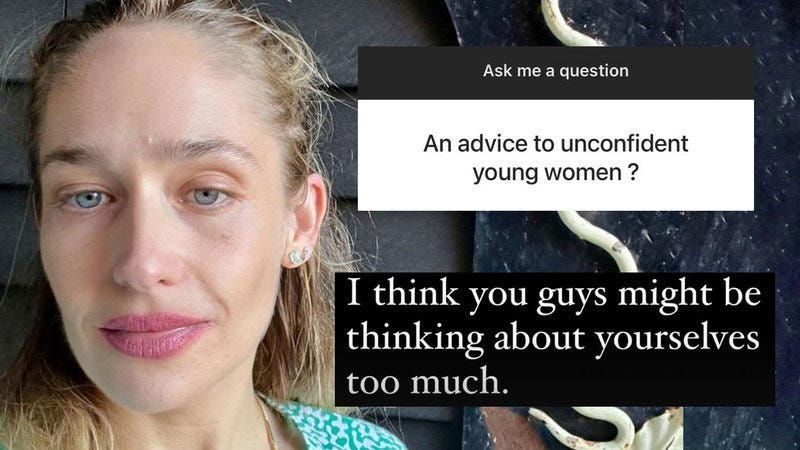
I decentralised myself. I realised it’s not about me. It’s about every woman’s experience, waiting to be seen, heard, and shared…
But let’s begin with today.
At this very moment, I’m writing to roughly 10,000 eyeballs, the kind, curious readers who’ve joined me on this email list. On an average day, about half of you open these letters and video stories.
In the 12 years I’ve been writing publicly, I’ve been met with so much kindness. One of my dearest friends is Japanese. Our friendship has lasted nearly two decades. She sent me a voice note this morning: “I’m so glad you write your stories and share them. You remind us about the sparkly parts of life. It’s a scary world out there. And you make it better.” She makes my world better too.
There have been a few sharp replies over the years, comments that sting or arrive laced with judgment. I chalk them up to this simple truth: how someone responds to me tells me more about them than it does about me. This wisdom holds in every area of life. People are projecting what’s happening inside them, and remembering this makes compassion easier. Boundaries too.
That’s the thing about putting yourself out there. You become a mirror. You invite people to see themselves in what you’ve shared. So it’s vital, imperative even, that you learn not to take it personally.
Right now I’m sitting in Lisbon Airport’s Terminal 2, at the only café with tables and chairs. A group of French businessmen are packed in beside me, their conversation staccatoing into my ears as I finish this. A flight to Paris is next to board.
I started this piece over a week ago, knowing it would be the last chance to invite you to join me in the club.
That’s often how my writing begins.
I have an idea. I pick it up and write it down. Often I pop things in Notes 📝 because the thing will land just as I’m heading out the door. Or in the shower. Or on a walk.
Sometimes I’ll start a new page in Pages or Substack, type a few lines, give it a title I’ll recognise later, then leave it alone. I let the idea breathe. Sometimes I return to it. Sometimes I start again. I let things percolate until they’re ready. And when they are, the words come quickly.
My boyfriend often says it looks like I can just sit down and write something fresh in an hour or two. And yes, sometimes I can. But what it looks like is rarely what it is. I spend all day every day, noticing. And that noticing forms thoughts, translated into words, becomes written.
Most of my writing has been quietly forming in some hidden partition of my mind for days, weeks, even years. It’s been composting. Gathering weight. Waiting for the moment it wants to emerge.
I remember a night, many years ago now, sitting cross-legged on the floor of my living room at 2 AM. Around me were teetering stacks of notebooks, filled with observations, essay fragments, and moments I’d never shared. Pages and pages that had never made it past my own eyes.
I was always the friend who urged others to write publicly, to submit to journals, to start a blog, to hit post on Instagram. “Your voice matters,” I’d tell them. I meant it every time. Meanwhile, I kept my own work in the shadows.
Every time my finger hovered over the “publish” button, a surge of anxiety would rise up. Who do I think I am? What if I reveal too much? What if it’s not good enough? What if it’s too much?
And so, again and again, I saved instead of sending.
I kept my words locked away in journals. Safe from judgment, yes. But also safe from connection.
This quiet resistance followed me for years.
What changed?
One day I stopped making it about me.
I realised I wasn’t writing for self-expression alone. I was writing to remind, to reflect, to connect. I was writing because somewhere, some woman, exhausted or elated or cracked open by life, might see herself in what I shared.
The words weren’t mine to keep. They never were.
And so I started thinking of my writing as a garden. Not a blog. Not a platform. A garden.
A living archive of stories, insights, and scraps of beauty that others might stumble across when they need them most. Something worth wandering through. Something that grows.
It helped to think of the silent readers, the ones who never hit reply or leave a comment, but who return again and again. I write for them too. You never know whose day or life your words are shifting, even if you never hear about it.
If you’re building a body of work, this also matters.
Anyone considering working with you or publishing you will need to read your writing multiple times before they know if your voice is a fit. If your writing lives out in the open, they can find it. Trust it. Choose it. But if you only publish once every few moons, what are they choosing from?
Your writing is not self-promotion.
It is an offering. A window. A breadcrumb trail back to some deeper part of the human experience, for others and for yourself.
Everything you’ve learned about shaping a sentence, translating emotion, and distilling clarity from the chaos of daily life is not meant to be hoarded. It’s meant to be shared.
This matters more than ever.
In a world increasingly flooded with synthetic, AI-generated words, human language crafted with care and shaped by hand becomes sacred again. This is the new counterculture, intimate, real, nuanced expression. Writing that makes someone feel less alone. Writing that notices. That names.
So if you’ve been waiting to share something, a piece, a post, a half-formed thought in your Notes app, consider this your gentle nudge.
~ Write for the version of you who once needed the words you now carry.
~ Write for the person out there who’s waiting to feel understood.
~ Write even if it’s quiet. Especially then.
~ Your writing might be exactly the permission someone else needs.
Your voice is not the point, but it is the portal.
 Vienda Maria